
Outdoor string lights and professional architectural lighting are defined by fundamentally different purposes, build standards, and expected lifespans. When comparing outdoor string lights vs professional lights, the core distinction is this: string lights are decorative and flexible, while professional systems are structural and permanent. Brands like Govee and Brightech dominate the consumer string light market with plug-and-play convenience, while professional outdoor lighting uses extruded aluminum hardware, low-voltage wiring, and smart controls designed to last decades. The right choice depends on your property's architecture, your HOA requirements, and how long you want your investment to last.
What are outdoor string lights, and how do commercial versions differ?
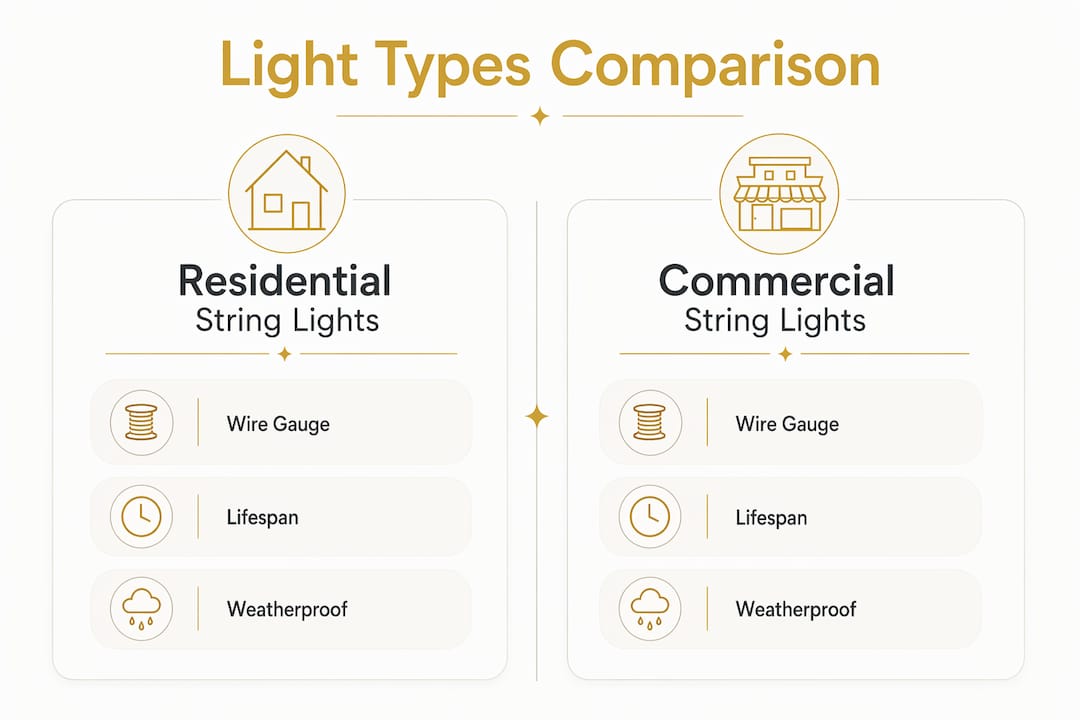
Outdoor string lights are decorative lighting fixtures strung on flexible wire, designed to create ambient light across patios, pergolas, and event spaces. The category splits into three tiers: standard residential, commercial-grade, and construction-grade. Each tier differs in wire gauge, weatherproofing, and intended use.
Standard residential string lights are not rated for continuous outdoor exposure. Consumer string lights scored up to 78/100 for ease of use but suffered water intrusion in 25% of bulbs during testing. That failure rate matters for any installation meant to last a full season outdoors.
Commercial-grade string lights solve most of those problems. Commercial string lights use heavy-duty wire (16AWG–18AWG), SJTW rubberized insulation, and IP65+ sealing, designed to withstand winds over 50mph. That engineering gap between residential and commercial is significant for any homeowner planning a permanent or semi-permanent patio setup.
Two brands define the commercial string light category: Brightech and Enbrighten. Brightech uses replaceable bulbs with mechanical IP65 seals, while Enbrighten uses permanently fused LEDs rated IP66/67 that require almost no maintenance. Enbrighten suits high, hard-to-reach installations. Brightech works better for low-hanging, accessible setups where bulb swaps are easy.
Key differences between string light tiers:
- Wire gauge: Residential uses 20–22AWG; commercial uses 16–18AWG for load capacity and heat resistance
- Weatherproofing: Residential is often unrated; commercial is IP65+; construction-grade meets OSHA standards
- Bulb design: Replaceable Edison-style (Brightech) versus fused LED modules (Enbrighten)
- Intended use: Residential for seasonal décor; commercial for year-round patios and event venues
| Feature | Residential String Lights | Commercial String Lights |
|---|---|---|
| Wire gauge | 20–22AWG | 16–18AWG |
| IP rating | Unrated or IP44 | IP65–IP67 |
| Bulb type | Replaceable incandescent | Replaceable or fused LED |
| Wind resistance | Low | 50mph+ |
| Lifespan | 1–2 seasons | 5+ years |
Pro Tip: If you are installing string lights on a covered patio that stays dry, Brightech's replaceable bulb design gives you more flexibility. For exposed rooflines or pergolas with no overhead cover, choose Enbrighten's fused LED system to avoid water intrusion.
How do professional outdoor lighting systems work?
Professional outdoor lighting, also called architectural landscape lighting, is a permanent electrical system designed into the structure of your home. It is not a product you buy at a hardware store. It is a custom installation built around your property's specific rooflines, gutters, and landscaping.
The hardware itself is engineered for invisibility. Professional permanent lighting uses extruded aluminum channels mechanically fastened behind gutters, with integrated weather-tight bulbs and 12V low-voltage wiring. During daylight hours, the hardware disappears against the roofline. That detail alone separates professional systems from any string light setup.
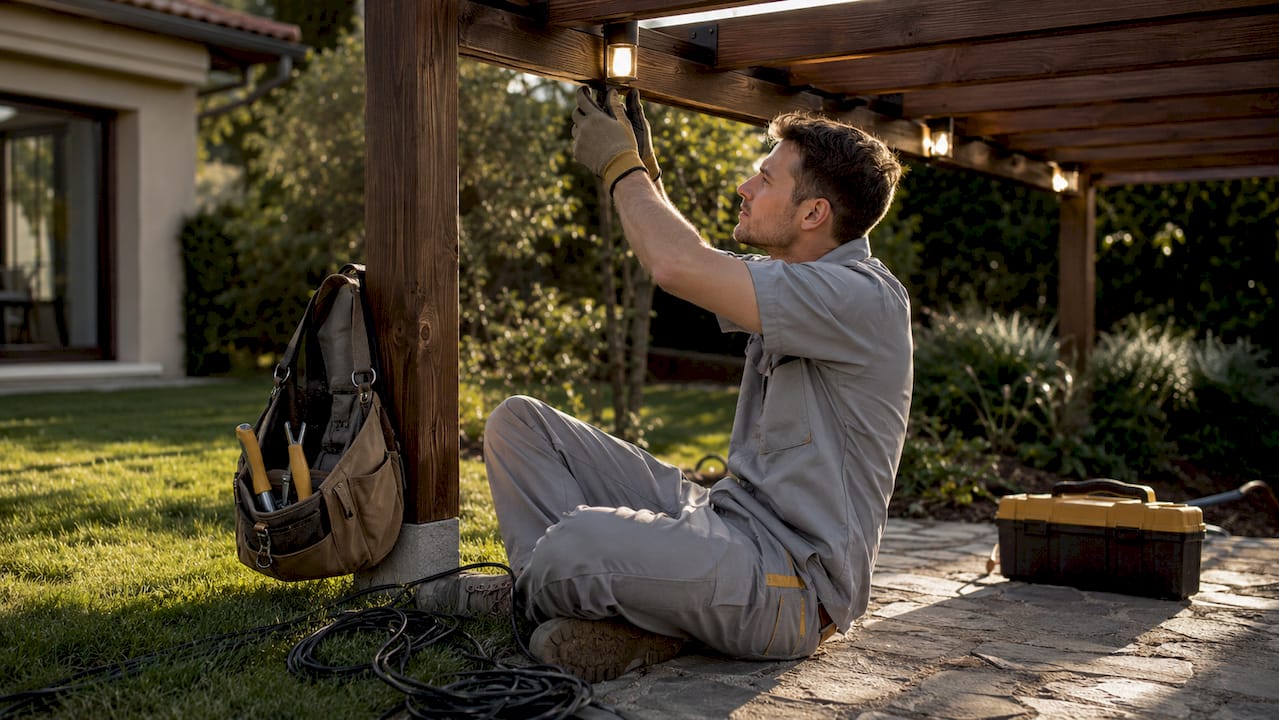
Control is another major differentiator. Professional systems use 12V low-voltage wiring paired with smart controllers and manufacturer apps, enabling color changes, scheduling, and scene programming far beyond what a plug-in timer can do. For holiday lighting or seasonal color changes, this means one tap on your phone replaces hours of physical work.
Here is how a professional installation typically unfolds:
- Site assessment at dusk. The designer evaluates your property under actual nighttime conditions to plan fixture placement and color temperature.
- Custom hardware fabrication. Aluminum channels are cut and finished to match your trim color, then mechanically fastened to the structure.
- Low-voltage wiring run. 12V wiring connects fixtures to a central controller, keeping the system safe and code-compliant.
- Smart controller programming. Scenes, schedules, and color profiles are configured through a manufacturer app.
- Final inspection and warranty documentation. Professional installations carry lifetime product and workmanship warranties, with zero homeowner labor required after completion.
HOA compliance is a practical advantage that often gets overlooked. Because the hardware is hidden behind gutters and trim, professional systems pass HOA review in neighborhoods like Bel Air, Beverly Hills, and Pacific Palisades where visible mounting hardware is prohibited.
Pro Tip: Ask your installer to program a "daytime off" scene that completely powers down fixtures during daylight hours. This extends LED lifespan and reduces energy consumption without any manual effort.
Cost, lifespan, and maintenance: a direct comparison
Price is where most homeowners start, but lifespan is where the real math happens. The outdoor lighting price hierarchy breaks down clearly: solar string lights cost $30–$60, commercial plug-in strings run $30–$80 per 50 feet, and professional whole-house systems start at $200–$400 and scale up from there.
That upfront gap narrows fast when you factor in replacement cycles. Solar and basic string lights last 2–3 years. Commercial plug-in strings last 5+ years. Professional LED systems are rated for 50,000+ hours, which equals roughly 27+ years at five hours of use per night. A system you install once and never replace changes the total cost calculation entirely.
| Lighting Type | Upfront Cost | Lifespan | Maintenance Level |
|---|---|---|---|
| Solar string lights | $30–$60 | 2–3 years | Low (battery replacement) |
| Commercial plug-in strings | $30–$80 per 50ft | 5+ years | Medium (bulb swaps) |
| Professional permanent system | $200–$400+ whole-house | 10–27+ years | Low (warranty-covered) |
Maintenance differences are equally significant:
- String lights require seasonal takedown, storage, bulb replacement, and re-installation. Weather damage to sockets and wiring is common after two or three seasons.
- Commercial string lights with IP65+ ratings handle weather better, but exposed connections still degrade over time without periodic inspection.
- Professional systems require no homeowner maintenance. Repairs fall under warranty coverage, and the aluminum housing protects all electrical connections from UV exposure, water ingress, and wind stress.
The 15-year cost comparison tells the full story. Over 15 years, DIY string light setups cost $1,500–$2,500 plus 40+ hours of labor. Professional systems run $2,500–$5,500 total with zero ongoing labor. For homeowners who value their time, the professional option pays for itself.
When should you choose string lights vs. professional lighting?
The right lighting choice depends on four factors: how long you need the lights, how your property is governed, what aesthetic you want, and how much ongoing effort you are willing to invest.
String lights are the right call when:
- You need temporary or seasonal ambiance for a patio, backyard party, or holiday display
- Your budget is under $200 and the installation is low-stakes
- You are renting a property and cannot make permanent modifications
- You are setting up string lights for events where rental-grade hardware and large zip ties keep everything secure and visually clean for the duration
Professional lighting is the right call when:
- You own an upscale property where visible hardware or seasonal takedown looks out of place
- Your HOA restricts exposed wiring, clips, or non-architectural fixtures on the roofline
- You want year-round color control, holiday programming, and landscape illumination from a single system
- You are investing in a property in markets like Bel Air, Malibu, or Pacific Palisades where curb appeal directly affects value
The safety dimension also matters. Misusing residential string lights in high-traffic or fully exposed environments creates real safety hazards and drives up replacement costs. If your installation is on a high roofline, in a wind-exposed location, or intended to run year-round, residential-grade string lights are not the right tool.
Pro Tip: For event setups, always use commercial-grade string lights with a minimum IP65 rating and secure every connection point with proper hardware. Loose connections are the leading cause of mid-event failures.
Key takeaways
Professional outdoor lighting outlasts and outperforms consumer string lights in durability, aesthetics, and long-term cost when the property and use case justify the investment.
| Point | Details |
|---|---|
| String lights suit temporary use | Commercial-grade options like Brightech and Enbrighten work well for patios and events, not permanent installs. |
| Professional systems last 27+ years | LED-rated 50,000+ hours with lifetime warranties eliminate replacement cycles entirely. |
| HOA compliance favors professional lighting | Hidden aluminum hardware meets restrictions in Bel Air, Beverly Hills, and similar neighborhoods. |
| 15-year costs are closer than they appear | Professional systems cost $2,500–$5,500 total versus $1,500–$2,500 plus 40+ labor hours for DIY. |
| IP rating determines outdoor suitability | Choose IP65+ for any exposed outdoor installation; IP66/67 for high or hard-to-reach locations. |
What i have learned installing lights on estates across los angeles
After working on properties from Pacific Palisades to Bel Air, the pattern I see most often is this: homeowners underestimate how much the wrong lighting choice costs them over time. Not in dollars alone, but in the annual ritual of takedown, storage, bulb replacement, and reinstallation that string lights demand.
The clients who push back hardest on professional system pricing are usually the same ones who have replaced their patio string lights three times in five years. Once we walk through the 15-year math together, the conversation shifts quickly.
HOA restrictions catch people off guard more than anything else. I have seen beautiful string light setups get flagged within a week of installation because the mounting hardware was visible from the street. Professional systems avoid that problem entirely because the hardware disappears behind the architecture. That is not a luxury feature. For many properties in Los Angeles, it is a requirement.
The misconception I push back on most is that string lights and professional lighting are interchangeable options at different price points. They are not. They solve different problems. String lights create mood for a season or an event. Professional architectural lighting transforms how a property reads after dark, every night, for decades. Matching the lighting type to the actual use case is the decision that matters most.
— Chris
Transform your property with professional outdoor lighting
If your property deserves more than a seasonal string light setup, Elegantoutdoorlights designs and installs permanent architectural lighting systems built for estates across Los Angeles. Every project is custom-designed at dusk, installed with commercial-grade hardware, and backed by a lifetime warranty.
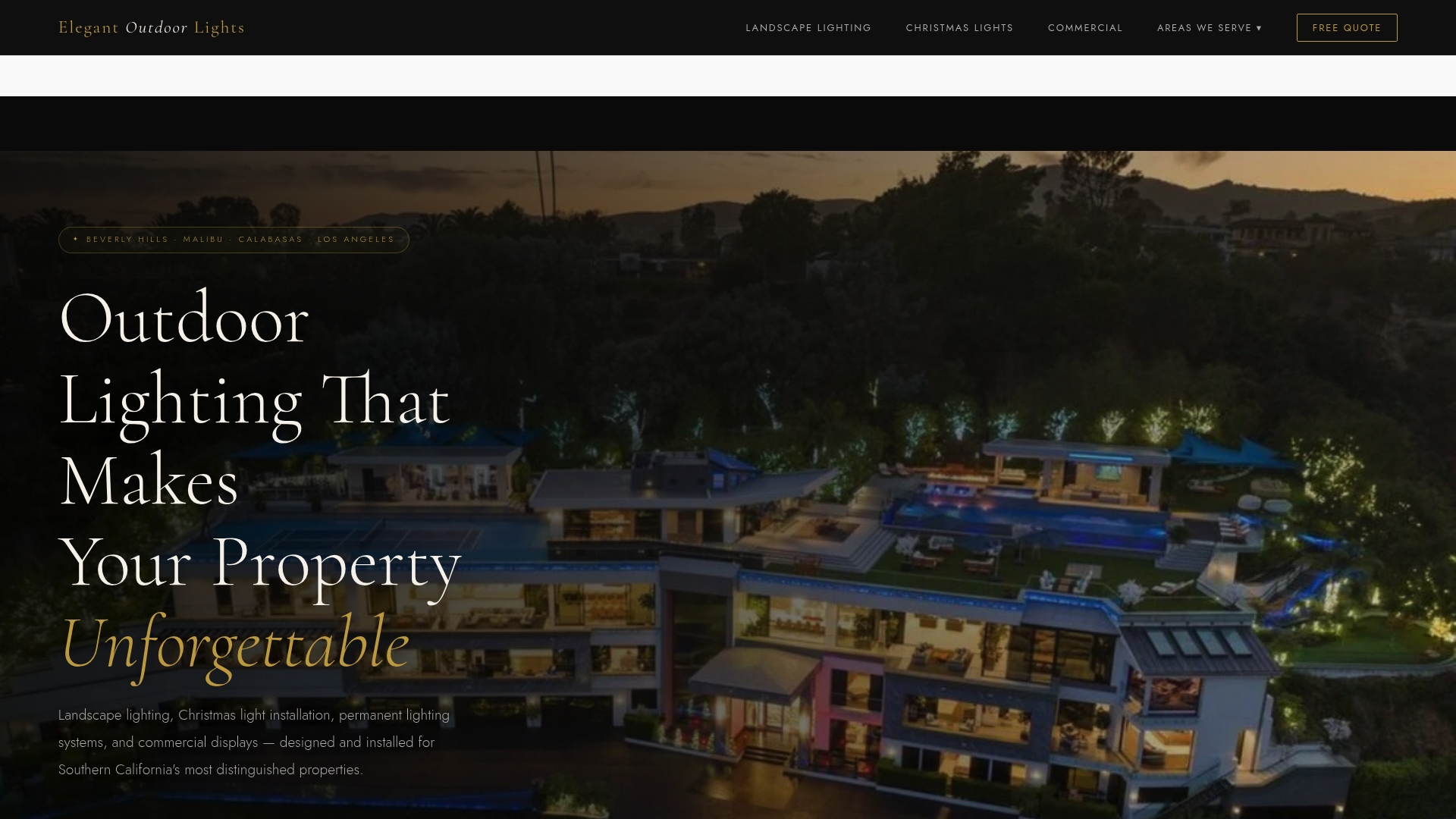
From landscape lighting design that defines your property after dark to full holiday installations that turn your home into a neighborhood landmark, Elegantoutdoorlights delivers a white-glove experience from the first consultation to the final inspection. Serving Bel Air, Beverly Hills, Malibu, and Pacific Palisades, the team brings the same precision to every estate. Explore professional holiday lighting and schedule your custom design consultation today.
FAQ
What is the main difference between string lights and professional lights?
String lights are decorative and temporary, while professional outdoor lighting uses permanent aluminum hardware, low-voltage wiring, and smart controls designed for year-round use. Professional systems are invisible during the day and carry lifetime warranties.
Are commercial string lights good enough for a permanent patio setup?
Commercial-grade string lights from brands like Brightech and Enbrighten work well for semi-permanent patio use, with IP65–IP67 ratings and 5+ year lifespans. They are not a substitute for professional architectural lighting on high-end or HOA-governed properties.
How long do professional outdoor lighting systems last?
Professional LED systems are rated for 50,000+ hours, which equals roughly 27+ years at five hours of use per night. That lifespan, combined with lifetime workmanship warranties, makes them the most cost-effective option over a 15-year horizon.
Do professional lights meet HOA requirements?
Professional permanent lighting uses extruded aluminum channels mounted behind gutters, making the hardware nearly invisible during the day. This design meets HOA standards in upscale neighborhoods where exposed wiring or mounting clips are prohibited.
What IP rating should outdoor string lights have?
Any string light installed in an exposed outdoor location should carry a minimum IP65 rating. For high or hard-to-reach installations, choose IP66 or IP67 to prevent water intrusion and reduce maintenance needs.