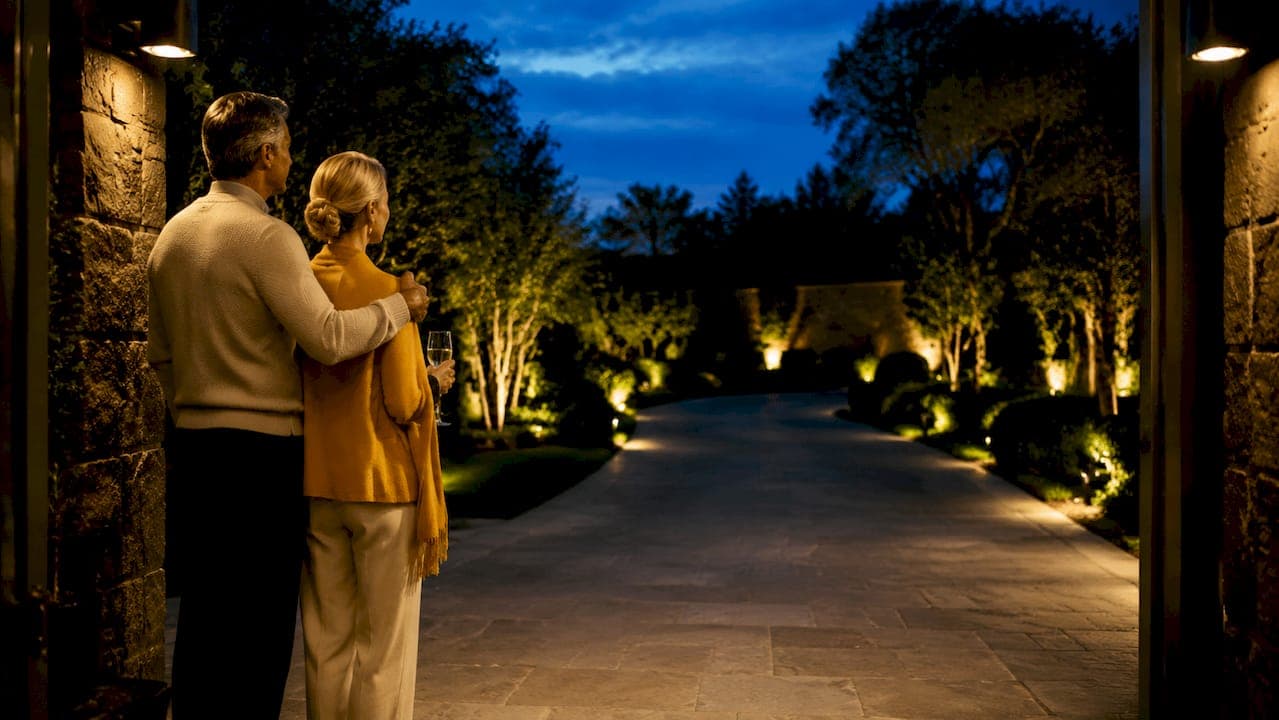
Driveway lighting design is defined as the planned placement of exterior fixtures to guide vehicles safely, define property boundaries, and create a polished arrival experience after dark. The main types of driveway lighting designs include path lights, bollards, in-ground recessed lights, post and pillar lights, and accent lighting. Each category serves a distinct purpose, and the best results come from combining them thoughtfully. Low-voltage LED fixtures deliver soft, downward illumination with minimal glare, making them the standard choice for residential driveways in 2026.
1. types of driveway lighting designs: path lights
Path lights are the most common starting point for any driveway lighting plan. They stand 12–24 inches tall, mount on ground stakes, and cast a soft downward glow along the driveway edge. Standard spacing guidelines recommend placing them every 8–12 feet in a staggered arrangement using warm white LEDs rated at 2700K–3000K. That color temperature mimics candlelight, which keeps the entrance feeling warm rather than clinical.
Path lights work on driveways of any length. On shorter driveways, four to six fixtures on alternating sides create a complete corridor of light. On estate driveways stretching 200 feet or more, the staggered pattern becomes especially important because it prevents the "airport runway" effect where two straight lines of bright lights feel harsh and institutional.
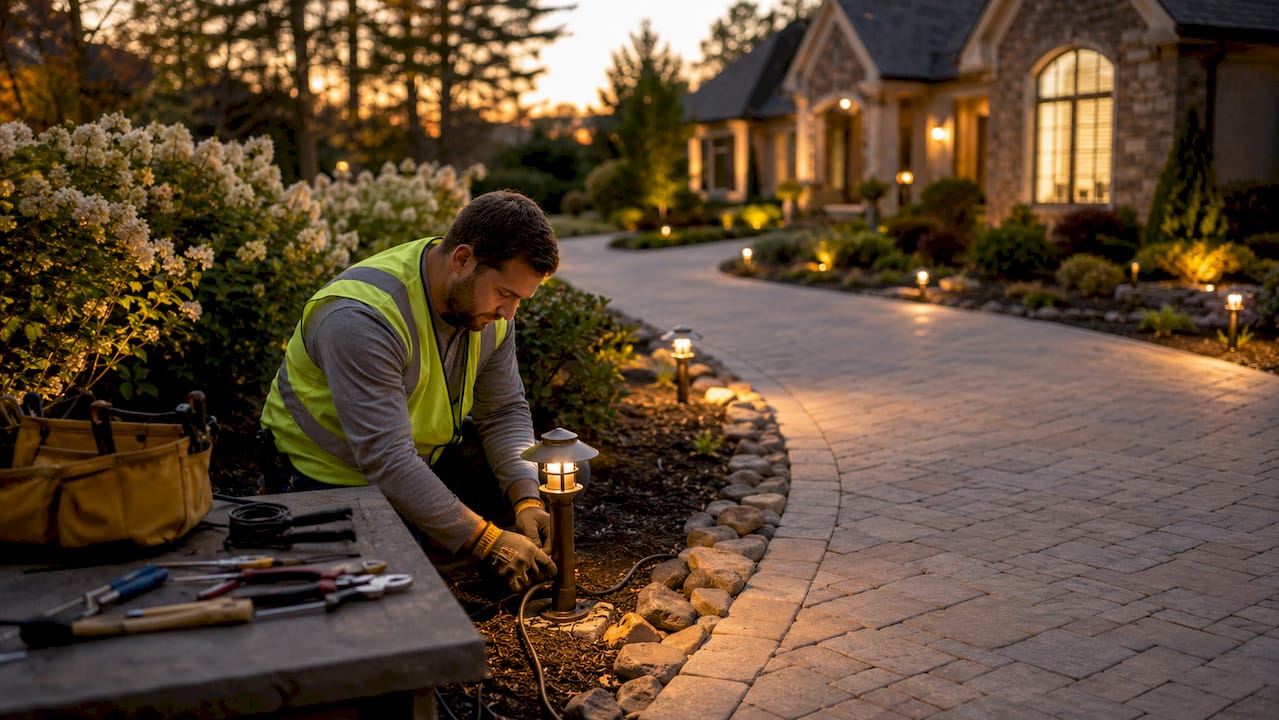
Pro Tip: Choose path lights with full-cutoff shielding so the bulb itself is never visible from the street. Visible bulbs create glare that makes it harder, not easier, to see where you are going.
2. bollard lights
Bollard lights stand 2–4 feet tall and offer a wider spread of illumination than low-profile path lights. They work particularly well on modern and contemporary homes where a clean, architectural silhouette reads as a design feature rather than just a utility fixture. Bollards serve as both light sources and physical markers, which makes them useful for defining driveway edges on properties with wide motor courts or circular turnarounds.
The taller profile means bollards are visible during the day as well, so material and finish selection matters. Powder-coated aluminum in matte black or brushed bronze integrates cleanly with most architectural styles. Spacing bollards every 10–15 feet on one side of a wide driveway creates a strong visual line without overcrowding the entrance.
3. in-ground recessed lights
In-ground lights sit flush with the driveway surface, making them the most discreet option available. They are ideal for minimalist estates where visible fixtures would interrupt a clean design. The critical technical requirement is that in-ground fixtures must carry an IP67 rating or higher to handle vehicle weight and moisture. Not every in-ground fixture is drive-over rated, and using the wrong product creates a safety hazard.
Installation is more involved than surface-mounted options. You need to core-drill the driveway surface, set a housing, and run conduit below grade. The payoff is a completely unobtrusive lighting effect that looks spectacular on pavers, concrete, and stone. In-ground lights work best at entry gates, along the edges of a motor court, or embedded in steps leading to the garage.
4. post and pillar lights
Post and pillar lights are the traditional choice for estate entrances. A matched pair of lantern-style fixtures mounted on stone or brick pillars flanking the driveway entrance signals arrival in a way no other fixture type can replicate. These fixtures draw from classical architecture and pair naturally with homes in the Georgian, Colonial, Mediterranean, and French Country styles.
The scale of the fixture must match the pillar and the home. A small lantern on a large stone pillar looks like an afterthought. A fixture with a 16–20 inch diameter and a height of 24–30 inches reads correctly on a pillar that stands 5–6 feet tall. Warm amber LED bulbs inside a clear or seeded glass enclosure produce the most authentic, welcoming glow.
5. accent and mood lighting
Accent lighting covers uplighting, downlighting, and moonlighting. Each technique adds a layer of atmosphere that functional path lights alone cannot provide. Layered lighting combining path lights with uplighting, downlighting, and architectural washes creates a cohesive arrival experience that feels intentional and refined.
- Uplighting places a fixture at the base of a tree, hedge, or architectural element and aims the beam upward. It creates drama and draws the eye to the property's best features.
- Downlighting mounts fixtures in trees or on structures and casts light downward, mimicking natural moonlight. This technique is called moonlighting, and it produces the softest, most natural-looking effect available.
- Architectural washes graze light across a stone wall, gate column, or garage facade to reveal texture and add depth.
These techniques are what separate a functional driveway from a designed arrival sequence.
6. solar spike lights
Solar spike lights stand 12–24 inches tall and require no wiring, which makes them the most flexible option for driveways where running conduit is impractical. Spike lights create overlapping pools of light for a continuous glow along garden paths and driveway edges. They charge during the day and activate automatically at dusk.
The honest limitation of solar fixtures is output consistency. In shaded driveways lined with mature trees, panels do not charge fully, and light output drops noticeably by midnight. For a luxury estate where consistent performance matters, solar works best as a supplemental layer rather than the primary light source. Use them along garden borders adjacent to the driveway rather than as the main edge guidance system.
7. smart lighting controls
Smart controls are not a fixture type, but they transform how every other fixture type performs. A smart low-voltage transformer paired with a system like Lutron Caseta or CAST Lighting allows you to set scenes, dim fixtures, and schedule lighting sequences from a phone. You can run the full driveway at 100% brightness when guests arrive and drop to 30% for overnight security lighting.
Precision optical control with asymmetric lens modules steers light exactly where it is needed on large driveways while eliminating glare and minimizing light pollution. That level of control is what distinguishes a professionally designed system from a DIY installation. Smart controls also extend lamp life by reducing operating hours and average output levels.
How to choose the right driveway lighting design
Selecting the right combination of fixtures starts with four practical considerations.
- Measure your driveway. A 40-foot straight driveway needs a different approach than a 300-foot curved motor court. Longer driveways benefit from bollards or taller path lights that remain visible at distance. Curved driveways need fixtures on the outside of each curve to guide the eye through the turn.
- Match the architecture. Traditional homes call for lantern-style post lights and warm amber tones. Modern homes suit bollards, in-ground lights, and fixtures with clean geometric profiles. Mixing styles creates visual noise.
- Prioritize glare control. Bright, unshielded fixtures pointed at eye level make driving more dangerous, not less. Uniform illumination with even coverage at 1–5 lux is the safety standard. More lumens do not equal more safety.
- Choose your power source. Low-voltage LED systems wired to a transformer offer the most reliable and consistent output. Solar works in fully exposed locations. Line-voltage systems are rarely necessary for residential driveways and create more risk during installation.
Pro Tip: Walk your driveway at night before purchasing any fixtures. Note where you feel uncertain about the edge or the path ahead. Those are the exact spots where light is needed most.
Driveway lighting type comparison
| Fixture Type | Best Application | Aesthetic Style | Installation | Key Consideration |
|---|---|---|---|---|
| Path Lights | Any driveway length | Versatile | Easy | Space every 8–12 feet, staggered |
| Bollard Lights | Wide driveways, motor courts | Modern, contemporary | Moderate | Visible by day; choose finish carefully |
| In-Ground Recessed | Minimalist estates, gate entries | Discreet, luxury | Complex | Requires IP67 rating for drive-over use |
| Post and Pillar Lights | Estate entrances | Traditional, classical | Moderate | Scale fixture to pillar size |
| Accent Lighting | Trees, walls, architectural features | Atmospheric | Moderate | Layering creates depth and ambiance |
| Solar Spike Lights | Garden borders, low-traffic edges | Casual, flexible | Very easy | Output drops in shaded locations |
Creative driveway lighting ideas for luxury estates
The most memorable driveway lighting design for a luxury home treats the entrance as a sequence, not a collection of isolated fixtures. Every element from the gate to the garage door should feel connected.
"Treat driveway lighting as part of a cohesive arrival sequence linked to gates, pillars, and landscaping rather than isolated bright spots." — Seville Landscape
Here are the ideas that produce the most striking results on distinguished properties:
- Gate column uplights frame the entrance and signal arrival before a guest even turns in from the street.
- Moonlighting from mature oaks or sycamores casts dappled shadows across the driveway surface, creating a natural, cinematic effect that no ground-mounted fixture can replicate.
- Architectural washes on the garage facade add depth and prevent the garage doors from reading as a dark void at night.
- Connecting path lighting to the front walkway creates a continuous lit path from car to front door, which is both practical and visually cohesive.
- Dimming scenes for events allow the full driveway to glow at welcoming brightness for parties and drop to a quiet, low-level security setting on ordinary nights.
For homeowners exploring high-end residential lighting strategies, the consistent finding is that restraint outperforms excess. Five well-placed fixtures with precision optics outperform twenty mediocre ones every time.
Key takeaways
The most effective driveway lighting plan layers path lights, accent lighting, and architectural fixtures chosen to match the home's style, driveway geometry, and safety requirements.
| Point | Details |
|---|---|
| Layer multiple fixture types | Combine path lights, bollards, and accent lighting for depth and function. |
| Match fixtures to architecture | Traditional homes suit lantern post lights; modern homes suit bollards and in-ground fixtures. |
| Prioritize glare control | Use full-cutoff fixtures and warm LEDs at 2700K–3000K for safe, comfortable illumination. |
| Verify in-ground ratings | Only install drive-over in-ground lights with an IP67 rating or higher. |
| Treat the entrance as a sequence | Connect gate, pillar, driveway, and walkway lighting for a cohesive arrival experience. |
What i've learned designing driveways after dark
The biggest mistake I see on luxury properties is the assumption that more light means better light. Homeowners invest in beautiful stone driveways, mature landscaping, and custom gates, then install six unshielded floodlights that wash everything flat and blind anyone pulling in. The architecture disappears. The landscaping disappears. All you see is glare.
The approach that actually works is restraint combined with precision. Asymmetric optics in area lights steer light along the driveway axis without spilling into neighboring properties or the night sky. Warm white LEDs at 2700K make stone, wood, and planting look richer, not washed out. And layering three or four fixture types at different heights creates the kind of depth that photographs beautifully and feels genuinely welcoming in person.
My honest recommendation: design the lighting at dusk, on site, with actual fixtures in hand. No rendering or plan fully captures how light behaves on a specific surface at a specific time of year. The properties that look extraordinary after dark are the ones where someone stood in the driveway at 7:30 PM and made decisions based on what they actually saw.
— Chris
Transform your driveway with professional lighting design
A well-designed driveway lighting plan requires more than selecting fixtures from a catalog. It requires understanding how light behaves on your specific surfaces, at your specific latitude, against your specific architecture. Elegantoutdoorlights designs and installs custom landscape lighting for distinguished estates across Bel Air, Beverly Hills, Pacific Palisades, and Malibu. Every project is designed at dusk, installed by experienced professionals, and maintained to stay looking its best year-round. If you are ready to see what your property looks like after dark at its full potential, Elegantoutdoorlights is the team to call. Explore the full range of estate lighting services and request a custom design consultation.
FAQ
What are the main types of driveway lighting?
The main types are path lights, bollard lights, in-ground recessed lights, post and pillar lights, and accent lighting. Each serves a different aesthetic and functional purpose, and the best results come from combining two or more types.
How far apart should driveway path lights be spaced?
Path lights should be spaced every 8–12 feet in a staggered arrangement on alternating sides of the driveway. This spacing creates even coverage without creating a harsh, runway-style effect.
Do in-ground driveway lights need a special rating?
Yes. In-ground lights installed in a driveway must carry an IP67 rating or higher to safely handle vehicle weight and moisture exposure. Standard landscape in-ground fixtures are not drive-over rated and will fail under vehicle load.
What color temperature is best for driveway lighting?
Warm white LEDs rated at 2700K–3000K are the standard for residential driveways. That range produces a welcoming, natural-looking glow that flatters stone, wood, and planting without the harsh blue-white cast of higher color temperatures.
Can i mix different driveway lighting types?
Mixing fixture types is not just acceptable, it is the recommended approach. Layering path lights with uplighting, bollards, and pillar lights at different heights creates depth, ambiance, and a cohesive arrival experience that single-fixture plans cannot achieve.