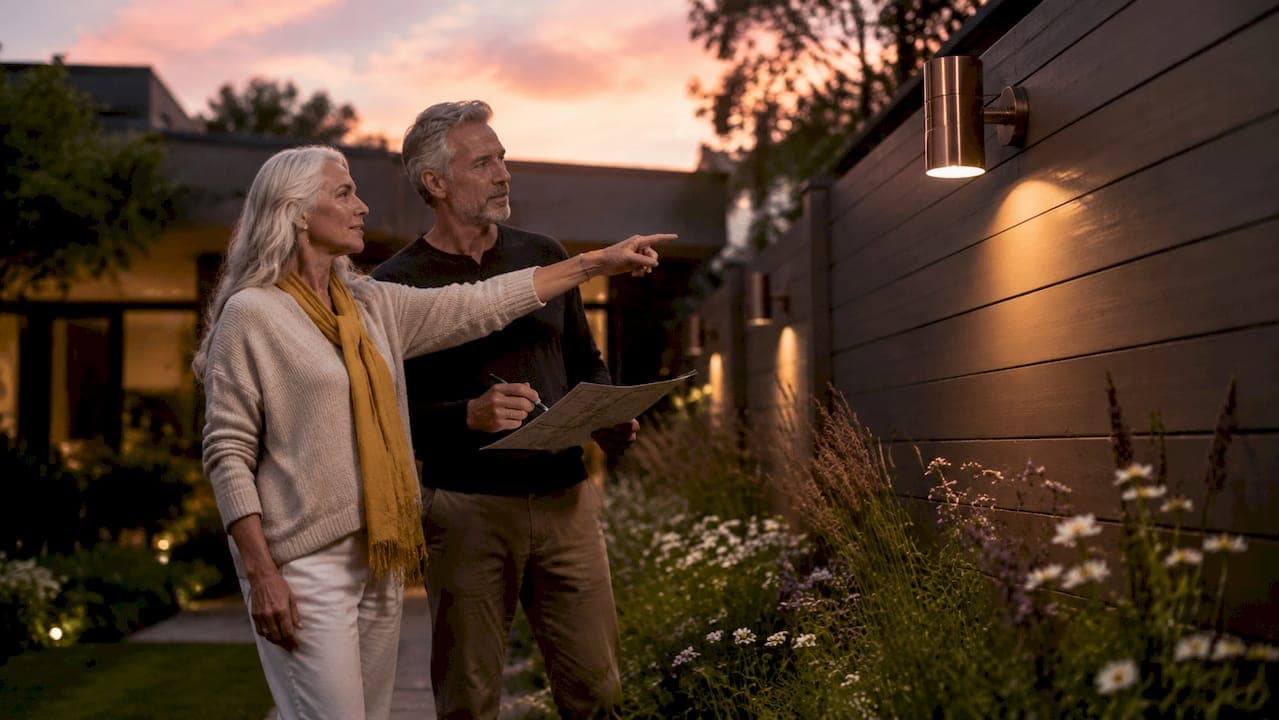
Exterior wall lighting is defined as any fixture mounted directly to an outdoor wall surface to deliver illumination for safety, security, or architectural effect. The four primary types of exterior wall lighting are decorative wall sconces, wall packs, up-down lights, and motion-sensor fixtures, with LED technology now the dominant choice across all categories. Choosing the right combination transforms a property after dark while protecting it. This guide breaks down each fixture type, the materials that last, and the placement strategies that make every light count.
1. types of exterior wall lighting: decorative wall sconces
Decorative wall sconces are the most visible outdoor wall lamp style on residential properties. They define the character of an entryway, frame a garage door, or accent a covered porch with warm, welcoming light. Decorative wall lights typically emit 150–400 lumens at color temperatures between 2700K and 3000K, which is the sweet spot for warm, flattering light that reads as "home" rather than "facility."
The style range is wider than most homeowners realize. Your options include:
- Traditional lantern styles in oil-rubbed bronze or antique brass, ideal for Colonial, Craftsman, or Tudor architecture
- Modern geometric fixtures in matte black or brushed nickel, suited for contemporary and transitional homes
- Farmhouse designs with clear seeded glass and aged iron finishes
- Mid-century profiles with clean lines and warm brass accents
Material choice matters as much as style. Bronze, brass, and copper age gracefully and resist corrosion better than painted steel. For homes in Malibu or Pacific Palisades, coastal-grade fixtures with sealed finishes are the right call.
Pro Tip: Scale your sconces to the door height, not the wall. A fixture that looks right in a showroom often reads as undersized on a 10-foot exterior wall. As a general rule, mount sconces at 5.5 to 6 feet above the finished floor and choose a fixture height that is roughly one-quarter to one-third of the door height.
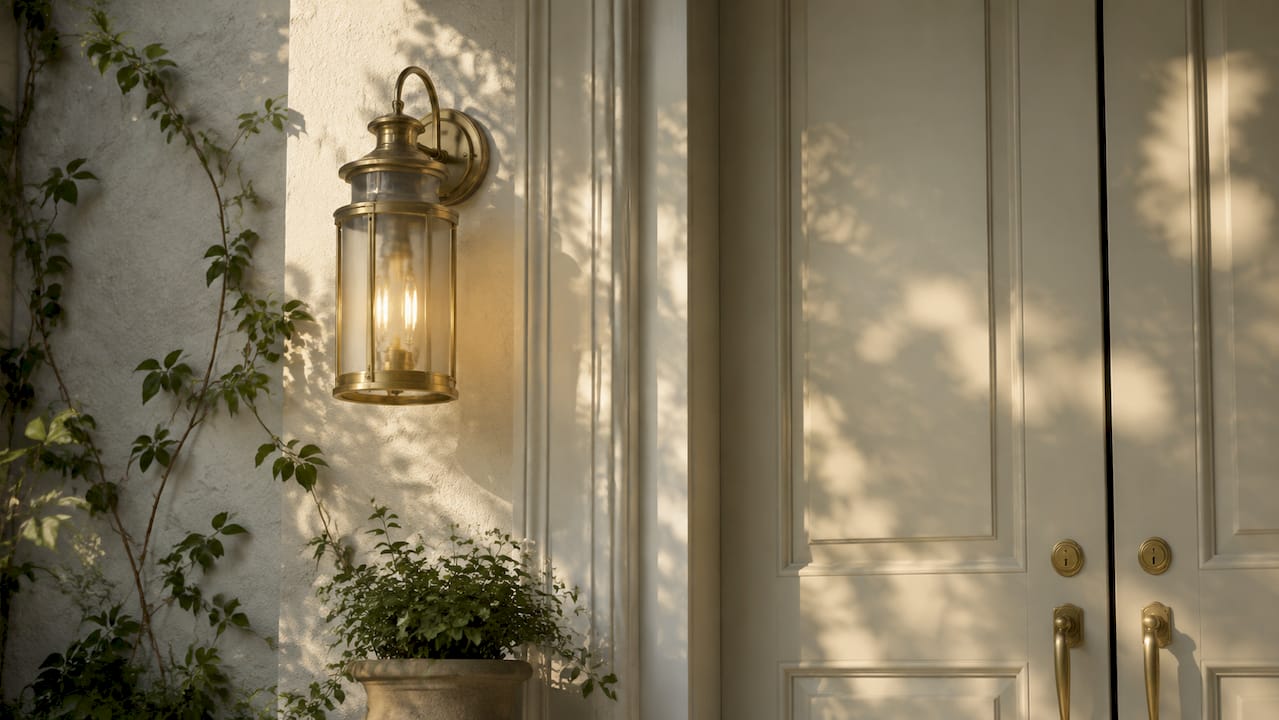
Improper sizing is one of the most common mistakes in residential exterior lighting. Sizable facades demand proportionally scaled fixtures to define architectural features and provide safe threshold illumination.
2. high-output wall packs for security lighting
Wall packs are the workhorses of exterior security lighting. They deliver multi-thousand lumen outputs from rugged, weather-resistant housings designed for long-term exposure. You will find them on garage walls, service entries, long blank side walls, and anywhere a property needs reliable perimeter coverage after dark.
The key performance factors to evaluate:
- Lumen output: Security applications require fixtures well above the decorative range. LED wall packs like the ZIBO series run from 27W to 68W with output scaled for forward throw or cutoff beam patterns.
- Beam control: Cutoff and full-cutoff designs direct light downward and forward, preventing spill onto neighboring properties.
- Wet rating: Any fixture on an exposed wall needs a wet-location rating. Damp-rated fixtures are not sufficient for open soffits or uncovered walls.
- Dimmability: LED fixtures are often dimmable down to 10%, which lets you reduce output during low-traffic hours without sacrificing coverage.
- Tunable white: Options with 2700K to 6500K tuning let you shift from warm evening ambiance to cool, alert-level brightness when motion is detected.
Pro Tip: Never rely on a single high-intensity wall pack to cover a large area. One bright source creates harsh shadows and blind spots at the edges. Two or three controlled fixtures at moderate output give you even coverage with no concealment zones.
Multiple controlled fixtures consistently outperform a single high-intensity source for both security coverage and visual comfort. That principle holds whether you are lighting a Beverly Hills motor court or a Studio City side yard.
3. up-down lights: architectural accent lighting
Up-down lights are wall-mounted fixtures that project two controlled beams, one upward and one downward, along a vertical surface. The effect is dramatic without being harsh. These fixtures work particularly well on feature walls, stone facades, wood-clad exteriors, and entry columns where you want to highlight texture and depth.
The practical benefits go beyond aesthetics:
- Architectural definition: Vertical light distribution draws the eye along the facade and makes a home read as intentional and well-designed after dark.
- Controlled output: Up-down fixtures at 21W and 40W deliver enough output to accent a facade without creating glare for neighbors or passersby.
- Layering potential: Pairing up-down lights with lower-output sconces creates depth. The sconces handle threshold illumination while the up-down fixtures handle the architectural story.
- Retail and hospitality crossover: These fixtures originated in commercial settings but have moved firmly into high-end residential design, particularly on estates with significant architectural investment.
Placement is everything with up-down lights. Space them evenly along a wall to create rhythm, and keep the beam spread tight enough that adjacent pools of light do not overlap and wash out the effect.
4. motion-sensor fixtures: security meets efficiency
Motion-sensor fixtures are the most energy-efficient exterior lighting option for areas that do not need continuous illumination. They activate on demand, which means full brightness exactly when it matters and near-zero draw the rest of the time.
Modern LED motion sensors integrate tunable white lighting, so the fixture can hold a warm 2700K glow at low output during quiet hours and snap to a cooler, brighter setting when motion triggers it. That combination serves both ambiance and security without requiring two separate fixtures.
The best placement scenarios for motion-activated wall lights include side gates, back entries, basement stairwells, and any approach path that is not visible from the street. These are the zones where continuous lighting feels excessive but zero lighting creates real risk. Motion sensors solve that problem cleanly.
Motion-sensor fixtures add convenience and energy savings while deterring intruders by eliminating the predictability of a fixed lighting schedule. An intruder who cannot tell when a light will activate is a deterred intruder.
5. choosing materials that last outdoors
The right fixture material is the difference between a five-year replacement cycle and a twenty-year installation. Outdoor wall light materials must reflect both architectural style and resistance to environmental exposure to deliver genuine longevity.
| Material | Best Environment | Lifespan Advantage | Watch Out For |
|---|---|---|---|
| Marine-grade brass | Coastal, high humidity | 2–3x longer than standard finishes | Higher upfront cost |
| Oil-rubbed bronze | Inland, moderate exposure | Strong corrosion resistance | Finish can wear unevenly |
| Matte black powder coat | Dry, low-humidity climates | Clean modern look | Chips in high-UV zones |
| Copper | All climates | Develops protective patina | Color change over time |
| Zinc alloy | Sheltered locations | Affordable, decent durability | Not for direct rain exposure |
Marine-grade materials provide 2–3x longer lifespan than standard painted or plated metals in coastal zones. For properties in Malibu, Pacific Palisades, or anywhere within a mile of the ocean, marine-grade is not optional. It is the baseline.
IP ratings tell you exactly how well a fixture handles water and dust. IP65 means fully dust-tight and protected against water jets. IP67 adds temporary submersion protection. For open exterior walls, IP65 is the minimum you should accept. Learn more about outdoor fixture material choices before finalizing your selection.
Pro Tip: Match your fixture finish to the dominant metal tone on your home's exterior. If your door hardware and house numbers are brushed nickel, a bronze sconce will read as an afterthought. Consistency across small details is what separates a designed exterior from a decorated one.
6. strategic placement for maximum impact
Placement determines whether your exterior wall lighting looks designed or accidental. The goal is even facade illumination with no dark gaps, no glare, and no wasted light spilling where it does not belong.
Follow these placement principles for the best results:
- Mount sconces at 5.5–6 feet above grade at all primary entries. This height puts light at eye level for arriving guests and illuminates the walking surface directly below.
- Space wall packs evenly along long walls so coverage pools overlap slightly. Gaps between pools create shadows that undermine security.
- Use cutoff beam designs on any fixture near a property line. Cutoff designs minimize light trespass and keep you in good standing with neighbors and local ordinances.
- Direct up-down lights at textured surfaces. Smooth stucco reflects light evenly. Stone, brick, and wood siding create shadow and depth that make the fixture worth installing.
- Layer fixture types rather than relying on one category. Decorative sconces handle the welcome, wall packs handle the perimeter, and up-down lights handle the architecture. Layered exterior lighting avoids over-lighting and creates dynamic visual interest.
- Integrate with landscape lighting for a cohesive after-dark experience. Wall fixtures and landscape lighting design work together when beam directions and color temperatures are coordinated.
Mounting height and beam direction significantly affect both functional illumination and security coverage. Getting these two variables right costs nothing extra and makes every other decision pay off.
Key takeaways
The most effective exterior wall lighting strategy combines decorative sconces, security-grade wall packs, and accent fixtures selected for material durability and precise placement.
| Point | Details |
|---|---|
| Match fixture type to function | Use sconces for entries, wall packs for perimeter security, and up-down lights for architectural accents. |
| Prioritize material for your climate | Marine-grade brass or copper lasts 2–3x longer than standard finishes in coastal or high-humidity zones. |
| Layer light types for best results | Combining decorative, security, and accent fixtures creates depth and avoids harsh over-lighting. |
| Use cutoff beam designs | Cutoff fixtures prevent light trespass, reduce glare, and keep coverage focused where it matters. |
| Scale fixtures to the architecture | Undersized fixtures on large facades fail both aesthetically and functionally. |
What i've learned designing exterior lighting for estate properties
Most homeowners focus almost entirely on the fixture style and almost not at all on placement and output. That is the wrong order of priorities. A beautiful sconce mounted at the wrong height, aimed at the wrong surface, or undersized for the wall it is on will disappoint every time.
The other mistake I see constantly is treating security lighting and decorative lighting as two separate projects. They are not. The best residential exterior lighting I have worked on integrates both into a single, coordinated plan. The sconces at the front door set the tone. The wall packs on the garage and side walls handle the perimeter. The up-down lights tell the architectural story. Each layer has a job, and none of them overlap awkwardly.
Material selection is where I push back hardest with clients. Standard painted finishes look fine in a showroom and start degrading within two years on a coastal property. If you are investing in quality fixtures, choosing the right outdoor lighting for your specific environment is the decision that protects that investment long-term.
The trend moving through 2026 is managed, layered illumination over raw brightness. More light is not better light. The properties that look genuinely stunning after dark are the ones where every fixture is doing a specific job at the right output level. That takes planning, not just purchasing.
— Chris
Transform your property with expert exterior lighting
Elegantoutdoorlights designs and installs exterior wall lighting for distinguished residential properties across Los Angeles, from Beverly Hills to Malibu. Every project is custom-designed at dusk, so you see exactly how each fixture performs on your specific architecture before a single screw is set.
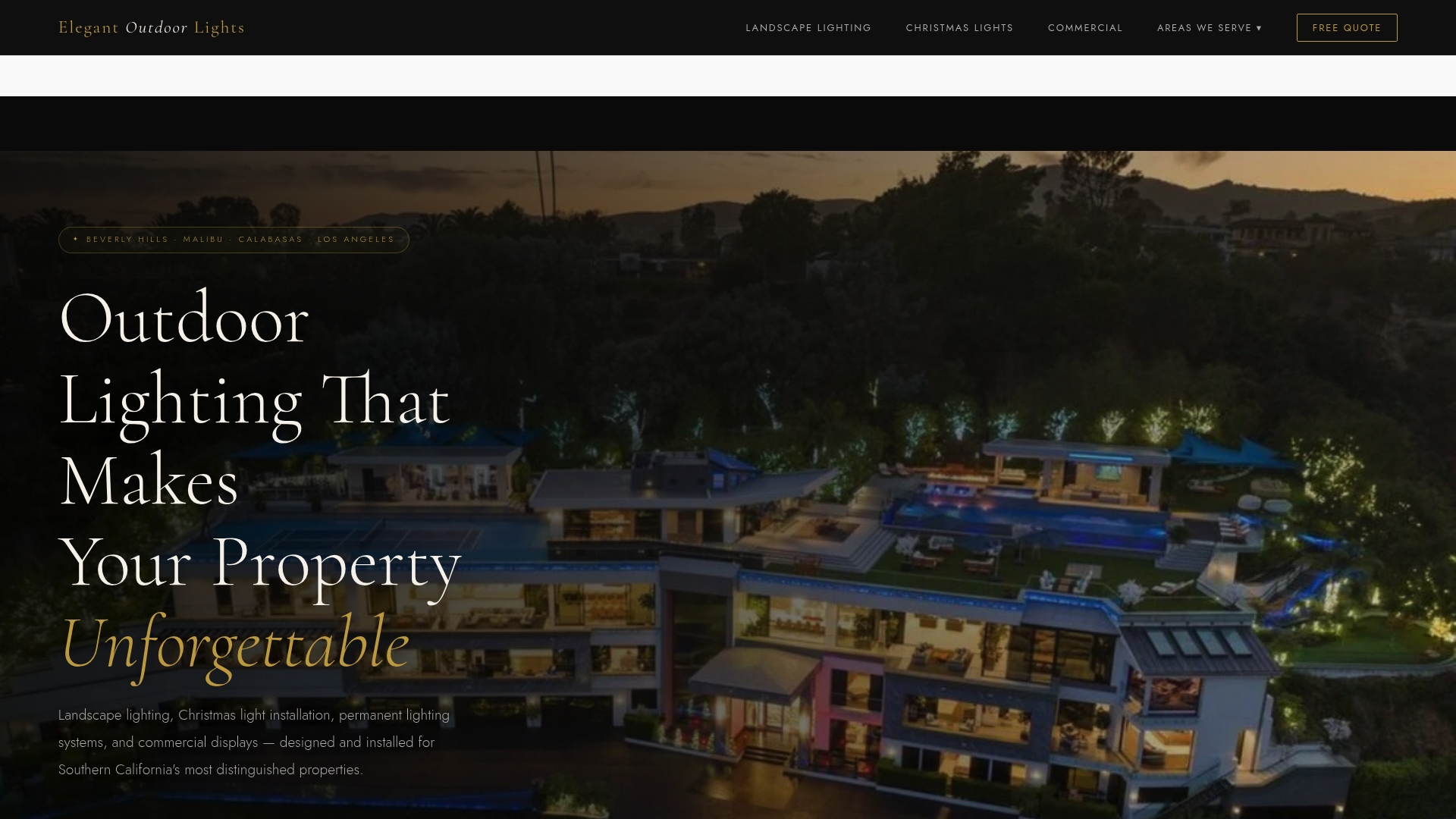
Whether you need commercial-grade wall fixtures for a large estate perimeter or a refined decorative scheme for a Pacific Palisades entry court, Elegantoutdoorlights delivers a white-glove experience from design through installation. Explore our Orange County residential projects to see how we balance style, security, and durability for homeowners who expect the best.
FAQ
What are the main types of exterior wall lighting?
The four primary types are decorative wall sconces, high-output wall packs, up-down accent lights, and motion-sensor fixtures. Each serves a distinct purpose, from aesthetic enhancement to perimeter security.
What is the best wall light for outdoor security?
LED wall packs with cutoff beam patterns deliver the highest security performance. They produce multi-thousand lumen outputs, resist weather exposure, and direct light precisely where it is needed without spilling onto neighboring properties.
How do i choose the right material for outdoor wall fixtures?
Match the material to your climate. Marine-grade brass or copper is the right choice for coastal and high-humidity environments, providing 2–3x longer lifespan than standard finishes. Inland properties in dry climates can use powder-coated or oil-rubbed bronze fixtures reliably.
Are motion-sensor wall lights energy efficient?
Yes. Motion-sensor LED fixtures consume near-zero power during inactive periods and activate only when needed. Modern versions with tunable white technology also allow warm ambient output at low wattage during quiet hours.
What IP rating do outdoor wall lights need?
Fixtures on exposed exterior walls require a minimum IP65 rating, which means fully dust-tight and protected against direct water jets. Locations subject to heavy rain or direct spray benefit from IP66 or IP67 rated fixtures.