
A lighting designer is a specialist who builds comprehensive lighting systems embedded within a home's architecture to shape both its function and emotional character. This is not about picking fixtures. The role of lighting designer in principal homes covers everything from spatial analysis and circadian rhythm planning to technical specifications and control system integration. In luxury residences across Bel Air, Beverly Hills, and Pacific Palisades, lighting shapes emotion and guides movement in ways no electrician or interior decorator is trained to deliver. Getting this right requires bringing a lighting designer into the project before a single wire is pulled.
What is the role of a lighting designer in principal homes?
A lighting designer functions as both an optical engineer and a spatial psychologist. Their job is to determine why and where light lands, not simply which fixture looks good in a catalog. In a $10M+ estate, designer Anita Lang has noted that lighting is never an afterthought. It is an architectural foundation that defines how every room feels at 7 a.m., at dinner, and at midnight.
The home lighting designer role separates itself from fixture selection in one critical way: sequence. Lighting plans define activities, zones, and light requirements before a single fixture is specified. That sequence prevents a common and expensive mistake where product availability drives design decisions instead of the occupant's actual needs.
Lighting designers also carry responsibility for long-term performance. They write technical specifications, coordinate with architects and interior designers, and produce construction documents that electricians can execute precisely. Without that documentation, even a skilled electrician defaults to contractor patterns that damage the project's aesthetic.
When should a lighting designer join your home project?
Timing is the single most consequential decision in residential lighting design. The answer is unambiguous: during the schematic design phase, before electrical rough-in begins.

Stage 6 lighting corrections cost 5–10x more than interventions made at Stage 4. That cost multiplier reflects the reality of construction: once walls are closed and ceilings are finished, every change requires demolition, patching, repainting, and re-inspection. A lighting plan created after the fact is always a compromise.
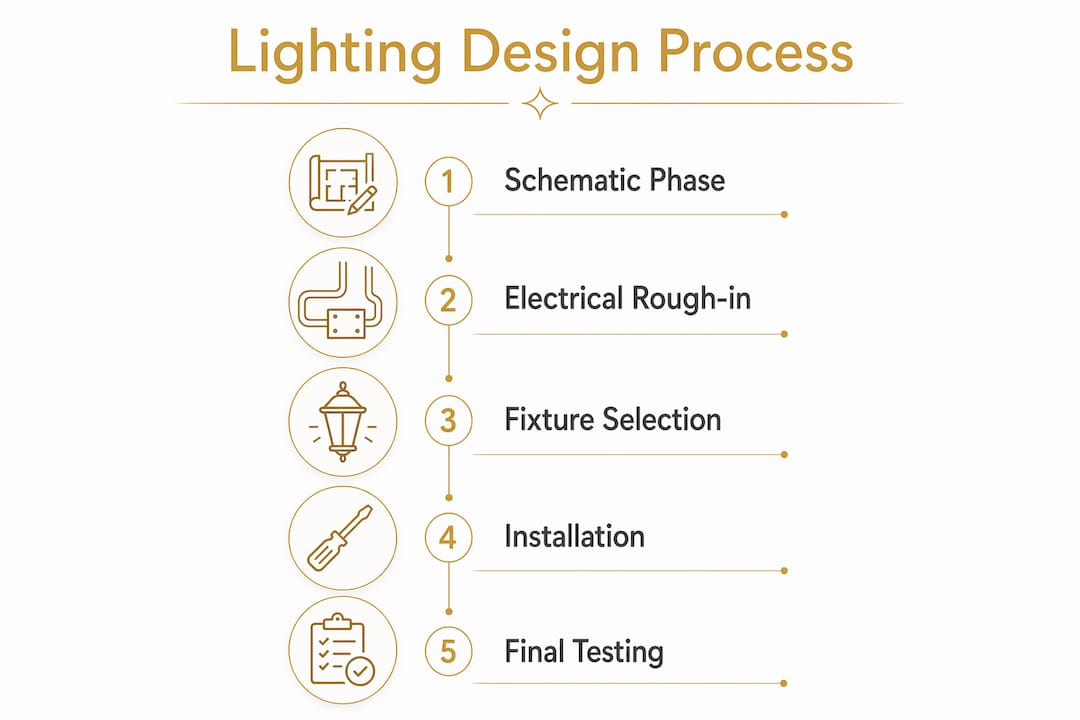
Here is the sequence that protects your budget and your outcome:
- Schematic design phase: Engage the lighting designer alongside the architect. Establish zones, activities, and mood goals for every space.
- Design development phase: Finalize fixture types, control systems, and dimming protocols. Produce Reflected Ceiling Plans and layout drawings.
- Construction documents phase: Integrate lighting specifications into the full set of working drawings so electricians have exact placement and circuiting instructions.
- Rough-in phase: Electricians pull wire to the exact locations specified. No guesswork, no default grid patterns.
- Trim-out and commissioning phase: The lighting designer returns to verify placement, adjust aim, and program control scenes.
Pro Tip: Ask your lighting designer to attend the electrical rough-in walk-through. Catching a misplaced junction box at that stage costs almost nothing. Catching it after drywall costs thousands.
Early-stage integration also ensures that smart control systems, motorized shades, and dimming infrastructure are baked into construction documents rather than retrofitted as afterthoughts.
What does comprehensive lighting design include?
Sophisticated residential lighting design is a system, not a collection of fixtures. Effective lighting combines four distinct layers with precise technical coordination across every room.
The four layers are:
- Ambient lighting: The base layer that provides general illumination. Think cove lighting, indirect LED channels, and large-format pendants on dimmer control.
- Task lighting: Directed, functional light for specific activities. Under-cabinet strips in the kitchen, reading sconces at the bedside, and vanity lighting in bathrooms all qualify.
- Accent lighting: Directional light that highlights architecture, art, or landscape features. Adjustable recessed fixtures and picture lights fall here.
- Decorative lighting: Fixtures that function as visual objects. A sculptural chandelier or a backlit onyx panel contributes to the room's character even when dimmed low.
Beyond layering, a lighting designer specifies the technical parameters that determine whether a space actually looks and feels right:
| Technical Parameter | What It Controls | Why It Matters |
|---|---|---|
| CRI (Color Rendering Index) | How accurately colors appear under the light | Low CRI makes art, skin tones, and finishes look flat or wrong |
| CCT (Correlated Color Temperature) | Warm vs. cool light, measured in Kelvin | Wrong CCT makes a warm room feel clinical or a bright space feel muddy |
| Beam angle | How wide or narrow the light spreads | Incorrect beam angles create hot spots, shadows, or wasted light |
| Dimming protocol | How fixtures respond to dimmer controls | Incompatible protocols cause flicker, buzz, and shortened fixture life |
Technical specifications like CRI, CCT, and dimming protocols determine whether lighting looks and feels right, independent of how beautiful the fixture itself appears. A stunning fixture with the wrong beam angle or a mismatched dimmer will underperform every time.
One of the most common failures in luxury homes is the "landing strip" effect: a uniform grid of recessed downlights across every ceiling. A coordinated multilayer system avoids this entirely by designing light to serve specific activities and zones rather than filling square footage. You can explore layering techniques for interiors to understand how each layer contributes to a finished space.
How does human-centric lighting benefit a principal home?
Human-Centric Lighting, or HCL, is the practice of adjusting artificial light to align with occupants' natural circadian rhythms throughout the day. It is one of the most significant advances in residential lighting design for residences over the past decade.
HCL links directly to improved sleep quality, mood, and daily function, and it increases property desirability and market value. That combination makes it a priority for any luxury home project where long-term livability matters.
In practice, HCL means programming lighting scenes that shift automatically across the day. Morning light runs cooler and brighter, around 5000–6500 Kelvin, to signal wakefulness. Afternoon light softens to a neutral 3500–4000 Kelvin. Evening light drops to a warm 2700–3000 Kelvin to prepare the body for rest. A lighting designer programs these transitions through a control system such as Lutron Homeworks or Crestron, so the home responds to time of day without manual adjustment.
Pro Tip: Specify tunable white fixtures in bedrooms, home offices, and primary living areas from the start. Retrofitting tunable white capability after construction is expensive and often architecturally disruptive.
Human-Centric Lighting not only improves occupant wellness but also enhances home marketability by aligning lighting with natural rhythms. For developers building in markets like Malibu or Bel Air, HCL is increasingly a selling point that sophisticated buyers expect to see.
Lighting designer vs. electrician: who does what?
The most common misconception in luxury home construction is that a skilled electrician can handle lighting design. The two roles are complementary, not interchangeable.
| Responsibility | Lighting Designer | Electrician |
|---|---|---|
| Spatial analysis and zone planning | Yes | No |
| Fixture placement and aim | Yes | No |
| CRI, CCT, and beam angle specification | Yes | No |
| Control system programming and scenes | Yes | Partial |
| Wire routing and circuit installation | No | Yes |
| Panel sizing and load calculations | No | Yes |
| Code compliance and inspections | No | Yes |
| Fixture trim-out and commissioning | Yes | Partial |
Lighting designers act as optical engineers and psychologists, focused on why and where light is placed. Electricians focus on technical power delivery and code-compliant installation. Neither role replaces the other.
The risk of relying solely on an electrician for lighting decisions is predictable: default grid patterns, mismatched color temperatures across rooms, and control systems that cannot be programmed for scenes or schedules. These outcomes are common in homes where lighting design was treated as part of the electrical scope rather than a separate discipline.
The best luxury projects feature a lighting designer and electrician working as a team, combining aesthetic intent with technical power delivery. That collaboration requires early and ongoing communication, particularly around circuiting decisions that affect which fixtures can be grouped on the same dimmer zone.
Architectural lighting design intentionally positions fixtures where light needs to land, not just where ceilings allow. That distinction separates a thoughtfully lit estate from one that simply has lights installed.
Key takeaways
A lighting designer's greatest value in a principal home is delivered before construction begins, not after it ends.
| Point | Details |
|---|---|
| Engage designers at schematic phase | Late-stage corrections cost 5–10x more than early-stage integration. |
| Design the system before the fixtures | Define activities and zones first; specify fixtures last to avoid product-driven compromises. |
| Use all four lighting layers | Ambient, task, accent, and decorative layers together prevent flat, uniform lighting. |
| Specify technical parameters precisely | CRI, CCT, beam angle, and dimming protocols determine how light actually performs in the space. |
| Pair designers with electricians | Lighting designers and electricians serve distinct roles; both are required for a luxury outcome. |
What i've learned after years of watching lighting go wrong
The most expensive lighting mistakes I have seen in luxury homes share one trait: the lighting designer was hired too late. By the time a homeowner realizes the recessed grid looks institutional or the kitchen feels cold at dinner, the walls are closed and the budget for corrections has evaporated.
What surprises most clients is how much lighting design is about restraint. The instinct in a large estate is to add more fixtures, more brightness, more coverage. The right instinct is to add fewer, better-placed sources with precise beam angles and layered control. A single well-aimed adjustable fixture grazing a stone wall does more for a room than six downlights pointed at the floor.
I have also watched the human-centric lighting conversation shift from a luxury add-on to a baseline expectation among serious buyers. Clients in Bel Air and Pacific Palisades are asking about circadian programming before they ask about fixture brands. That shift reflects a broader understanding that how a home feels across the day matters as much as how it photographs.
The one piece of advice I give every homeowner before they break ground: treat your lighting designer as a core member of the design team, not a consultant you bring in to pick fixtures at the end. The difference in outcome is not subtle. It is the difference between a house that looks beautiful in photos and one that genuinely transforms how you live in it.
— Chris
How Elegantoutdoorlights brings expert lighting to your estate

Elegantoutdoorlights designs and installs architectural landscape lighting for the most distinguished estates in Los Angeles, from Bel Air and Beverly Hills to Pacific Palisades and Malibu. Every project is custom-designed at dusk, professionally installed, and maintained with the same attention to detail that defines a true white-glove service.
Whether you are planning a new estate build, refreshing an existing property, or adding a seasonal holiday installation that matches the scale and character of your home, Elegantoutdoorlights brings the same discipline to outdoor lighting that a great interior lighting designer brings inside. The earlier you involve the team in your project, the better the outcome. Contact Elegantoutdoorlights to schedule a consultation before your next phase of construction begins, and see what purpose-built estate lighting design looks like in practice.
FAQ
What does a lighting designer do in a luxury home?
A lighting designer creates a complete lighting system by analyzing zones, specifying technical parameters like CRI and CCT, and producing construction documents that guide electricians. Their work covers everything from ambient and accent layers to control system programming.
When should i hire a lighting designer for my home project?
Hire a lighting designer during the schematic design phase, before electrical rough-in begins. Late-stage corrections cost 5–10x more than changes made during early design, making early engagement the most cost-effective decision.
Can my electrician handle lighting design?
An electrician handles power delivery, circuit installation, and code compliance. Lighting designers handle spatial analysis, fixture placement, beam angles, and control programming. Both roles are required for a high-quality luxury outcome.
What is human-centric lighting and why does it matter?
Human-Centric Lighting adjusts color temperature and intensity throughout the day to align with occupants' circadian rhythms. Studies link HCL to improved wellness and higher home desirability in luxury markets.
What is the "landing strip" effect in home lighting?
The landing strip effect describes a uniform grid of recessed downlights across a ceiling that produces flat, undifferentiated light. A layered lighting system using ambient, task, accent, and decorative sources eliminates this problem and creates spatial depth.