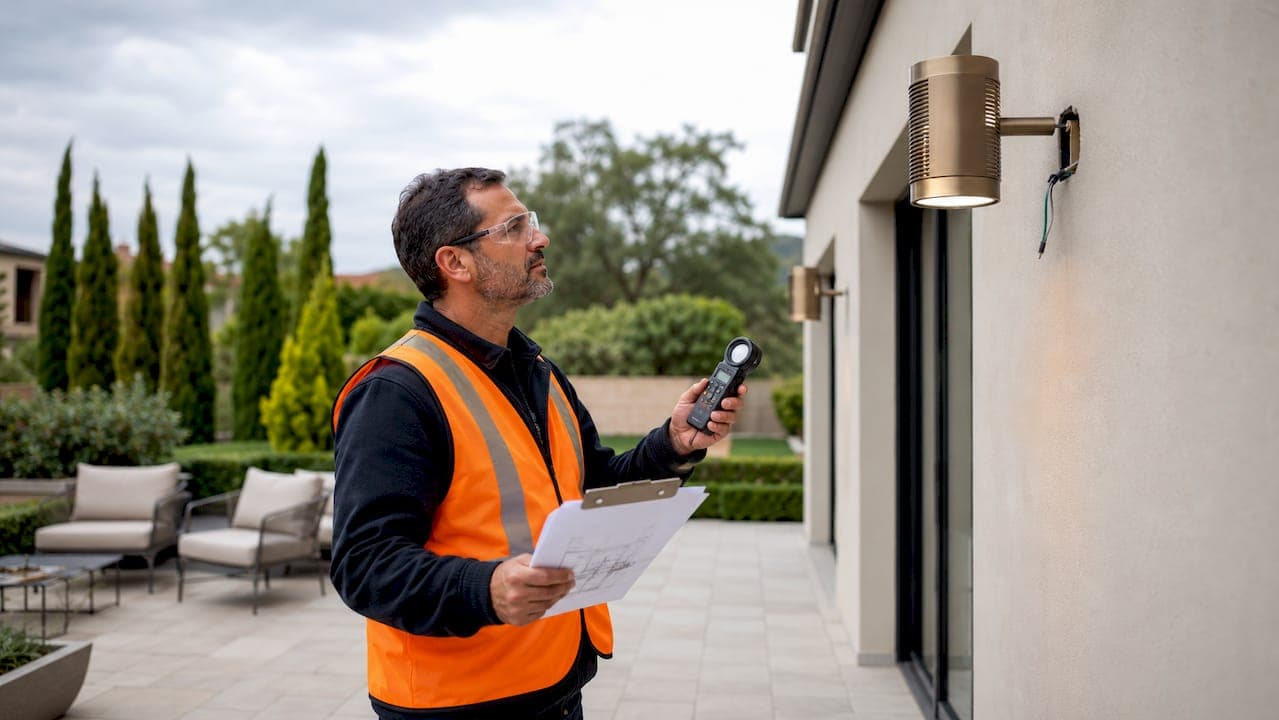
TL;DR:
- Commissioned lighting ensures systems perform exactly as designed by verifying, testing, and calibrating controls and fixtures. It is a thorough quality assurance phase that follows installation and involves documentation, scene programming, and sensor calibration. Proper commissioning results in energy savings, improved occupant comfort, and long-term system reliability.
Commissioned lighting installation is the process of verifying, testing, and optimizing a lighting system to confirm it performs exactly as designed and meets the homeowner's specific expectations. The industry term for this process is "lighting commissioning," defined by the Illuminating Engineering Society (IES) as verifying systems meet functional goals through testing and documentation. It goes well beyond flipping a switch to see if the lights turn on. For homeowners and property managers in Los Angeles, Beverly Hills, and Malibu, understanding what commissioned lighting installation delivers is the first step toward getting a lighting system that truly performs.
What is commissioned lighting installation and what does it include?
Commissioned lighting installation is a quality assurance process that closes the gap between a lighting designer's intent and what actually happens in your home after the wires are connected. The IES confirms that commissioning verifies performance criteria beyond simple activation, covering functional testing, documentation, and calibration. This matters because a lighting system can be fully wired and still fail to deliver the ambiance, energy efficiency, or control behavior you were promised.
The process covers every layer of a lighting system. Fixtures are tested for correct output and placement. Control systems are programmed with specific scenes and dimming levels. Sensors are calibrated to respond accurately to occupancy and natural light. Without this phase, even a beautifully designed system can underperform from day one.
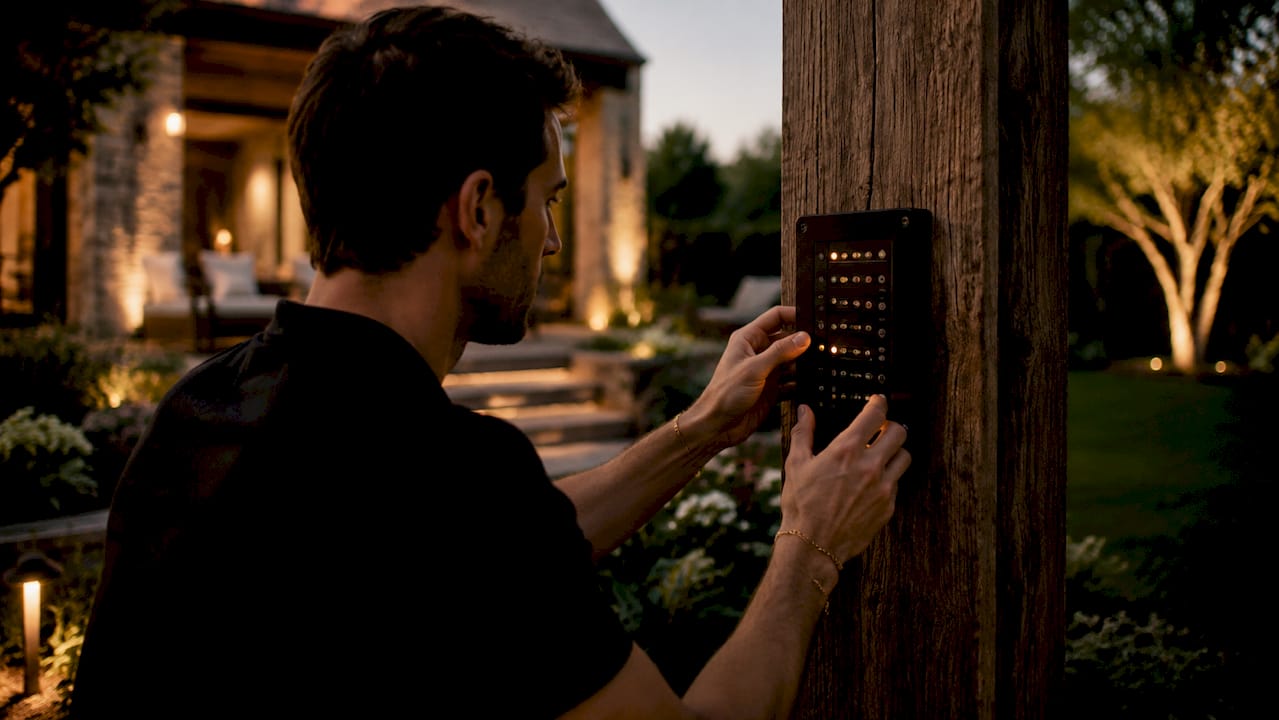
For residential and outdoor projects, commissioning also includes a final aiming phase. According to Guocio, post-installation commissioning aligns lighting aesthetics and controls with homeowner expectations from design renders. That means the warm wash of light across your garden wall or the dramatic uplighting on your estate's facade actually matches what you approved in the design presentation.
How does the lighting commissioning process work?
The professional lighting design commissioning process follows a structured sequence. Each step builds on the last, and skipping any one of them creates gaps that show up as complaints later.
-
Installation verification. The commissioning team checks that every fixture, cable run, and control device is installed according to the original design blueprints. Discrepancies are flagged and corrected before testing begins.
-
Functional testing of fixtures and controls. Each light is activated individually and as part of a group. The team confirms correct output, color temperature, and that controls respond as programmed.
-
Device addressing and zone mapping. Every fixture and sensor on a networked system receives a unique address. Simmtronic's commissioning checklist notes that incorrect device addressing causes lights to operate in wrong zones, creating frustration and wasted energy. Zone mapping confirms that the right lights respond to the right commands.
-
Sensor calibration and movement testing. Occupancy sensors and daylight sensors are calibrated to match actual space use. Simmtronic confirms that sensor validation during commissioning prevents wasted energy and dark zones by aligning lighting with real behavior patterns.
-
Programming smart scenes and dimming setups. Scenes are built into the control system: a "welcome home" setting for the driveway, a soft ambient mode for the terrace, a full-brightness security setting for the perimeter. Each scene is tested against the Control Intent Narrative.
-
Final aiming and optical adjustment. Adjustable fixtures are aimed precisely. Beam angles are set. Glare is eliminated. This is the phase where the lighting system stops being functional and starts being beautiful.
Pro Tip: Ask your commissioning provider for a written Control Intent Narrative before work begins. Expert Steve Mesh explains that clear control intent documentation allows objective testing against specific sequences of operations rather than subjective assessments. Without it, "commissioning" becomes a matter of opinion.
How is commissioning different from installation or startup?
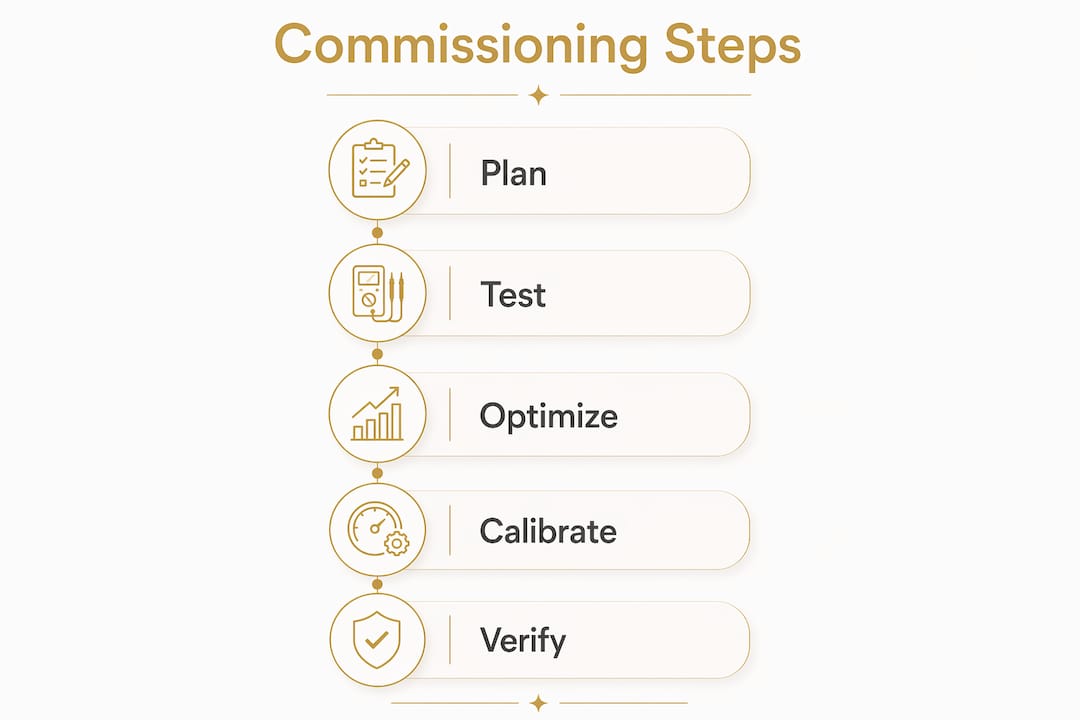
These three terms describe three distinct phases of a lighting project. Confusing them leads to real problems.
Installation is the physical work: mounting fixtures, pulling wire, connecting devices. An electrician completes this phase. The system is wired but not yet verified or programmed.
Startup is the next step. The Lighting Controls Academy explains that startup includes programming and testing of lighting controls but is narrower than commissioning. During startup, a technician confirms basic functionality and enters initial programming. It is faster and less thorough than full commissioning.
Commissioning is the broadest phase. It is often performed by a third party or a specialist separate from the installation crew. It includes everything in startup plus comprehensive quality assurance, documentation, sensor calibration, and verification against design intent.
| Phase | Who performs it | What it covers |
|---|---|---|
| Installation | Electrician | Physical wiring and fixture mounting |
| Startup | Controls technician | Basic programming and functional checks |
| Commissioning | Specialist or third party | Full QA, calibration, documentation, and scene programming |
The Lighting Controls Academy warns that confusing startup with commissioning leads many projects to skip broader quality assurance steps, resulting in underperforming systems. For homeowners investing in custom lighting installation for a Bel Air estate or a Pacific Palisades garden, that shortcut is expensive.
Common misconceptions include:
- Believing the electrician's sign-off means the system is commissioned
- Assuming startup programming covers all scene and sensor work
- Thinking commissioning is only necessary for commercial buildings
What are the key benefits of commissioned lighting for homeowners?
The benefits of commissioned lighting installation are practical, measurable, and long-lasting. They show up in your energy bills, your daily comfort, and the long-term cost of maintaining your system.
Energy efficiency. Accurate sensor calibration and daylight harvesting prevent lights from running when they are not needed. Mercury Lighting confirms that commissioning improves energy efficiency through verification, calibration, and control programming. A landscape lighting system that dims automatically at dawn instead of burning through the night is a direct result of proper commissioning.
Occupant comfort. Programmed lighting scenes match the way you actually use your spaces. A terrace set for evening entertaining looks different from a driveway set for late-night arrivals. Commissioning builds those differences into the system so they happen automatically.
Compliance with design standards. Your lighting designer created a specific vision. Commissioning verifies that the installed system delivers it. Without this verification, you may pay for a premium design and receive a generic result.
Reduced maintenance costs. Mercury Lighting notes that commissioning reduces post-installation fixes by catching errors before they become recurring problems. A sensor miscalibrated at installation will generate service calls for years. Catching it during commissioning costs far less.
Better documentation for future work. A commissioned system comes with records: zone maps, scene programs, sensor settings, and control sequences. When you expand your property or update your lighting, that documentation saves significant time and money.
How to choose and prepare for commissioned lighting services
Selecting the right provider for commissioned lighting services requires more than checking a license. The quality of commissioning depends on experience, documentation practices, and the ability to work alongside your existing design team.
Look for these qualifications in a commissioning provider:
- Experience with residential and estate-scale projects, not just commercial buildings
- Familiarity with the specific control systems specified in your design (Lutron, Control4, or similar platforms)
- A clear process for producing and using a Control Intent Narrative and Sequence of Operations
- References from projects with comparable scope and property type
Questions worth asking before you sign a contract:
- Who performs the commissioning, and are they separate from the installation crew?
- What documentation will you receive at the end of the process?
- How do you handle sensor calibration for outdoor and landscape zones?
- What is your process if a fixture or control device fails testing?
Preparing your property for commissioning also matters. Spaces should be furnished and finished before sensor calibration begins, because occupancy sensors respond differently in empty rooms. Outdoor zones should be tested at dusk, when actual light levels match the conditions the system will operate in daily.
Pro Tip: Work with a lighting designer who provides a written Sequence of Operations before commissioning begins. This document defines exactly how each zone should behave, giving the commissioning team an objective standard to test against.
Collaborating with your electrician and lighting designer during commissioning prevents miscommunication. The commissioning specialist needs access to the original design drawings, the control system login credentials, and a clear point of contact who can approve final scene settings on your behalf.
Key Takeaways
Commissioned lighting installation is the quality assurance phase that separates a lighting system that looks right on paper from one that performs beautifully every night.
| Point | Details |
|---|---|
| Commissioning is not installation | It is a separate quality assurance phase covering testing, calibration, and programming after wiring is complete. |
| Startup and commissioning differ | Startup covers basic programming; commissioning is a broader, more thorough verification process often done by a specialist. |
| Sensor calibration prevents waste | Properly calibrated occupancy and daylight sensors stop lights from running when they are not needed. |
| Documentation protects your investment | A Control Intent Narrative and zone maps make future maintenance faster and less costly. |
| Final aiming delivers the design | Adjusting fixture angles and programming scenes is what turns a wired system into the lighting vision you approved. |
Why commissioning is the step most homeowners never knew they needed
I have seen beautiful lighting designs fall flat because the commissioning phase was either skipped or handed off to the installation electrician as an afterthought. The wiring was correct. The fixtures were quality. But the sensors triggered at the wrong times, the scenes felt generic, and the outdoor uplighting aimed at the wrong architectural features. The homeowner assumed the system was working because the lights turned on.
The real value of commissioning shows up six months after installation, when a properly commissioned system is still performing exactly as designed and a skipped-commissioning system has generated three service calls. For estate-scale properties in Los Angeles, where evaluating installation proposals carefully is part of protecting a significant investment, commissioning is not optional. It is the difference between a lighting system and a lighting experience.
The most common mistake I see is homeowners treating commissioning as a luxury add-on rather than a core deliverable. If your contract does not explicitly include commissioning as a named phase with documentation requirements, you are not getting it. Ask for it by name. Require the paperwork. The lighting you were shown in the design presentation will not appear on its own.
— Chris
Elegantoutdoorlights: custom lighting installation for Los Angeles estates
Elegantoutdoorlights designs, installs, and commissions lighting for the most distinguished residential properties in Los Angeles, including Bel Air, Beverly Hills, Pacific Palisades, and Malibu. Every project includes a full commissioning phase: fixture verification, sensor calibration, scene programming, and final aiming at dusk to confirm the result matches the design.

Whether you are planning a year-round landscape lighting installation or a full estate holiday lighting display, Elegantoutdoorlights delivers a white-glove experience from the first design consultation through final commissioning and ongoing maintenance. Contact Elegantoutdoorlights to schedule a consultation for your property.
FAQ
What is the difference between lighting commissioning and installation?
Installation is the physical process of mounting fixtures and running wiring. Commissioning is the quality assurance phase that follows, verifying the system performs as designed through testing, calibration, and programming.
Does every residential lighting project need commissioning?
Any project with smart controls, sensors, or programmed scenes benefits from formal commissioning. The IES defines commissioning as the process that confirms systems meet functional and design goals, which applies directly to residential lighting with control systems.
How long does the commissioning process take for a home?
The timeline depends on system complexity and property size. A single-zone outdoor system may take a few hours, while a full estate with multiple control zones, sensors, and programmed scenes can require one to two days.
What documents should I receive after commissioning is complete?
A properly commissioned system comes with a zone map, scene program records, sensor calibration settings, and a Sequence of Operations document. These records are the foundation for any future maintenance or system expansion.
Can my electrician handle commissioning, or do I need a specialist?
Electricians handle installation. Commissioning requires a specialist familiar with control system programming, sensor calibration, and design intent verification. The Lighting Controls Academy notes that treating startup as commissioning is a common pitfall that leads to underperforming systems.