
TL;DR:
- A full service lighting contract is a subscription agreement that includes design, installation, maintenance, and upgrades for a fixed fee. It shifts capital expenses into predictable operational costs and guarantees performance over 2 to 5 years. Proper contract terms focus on response times, maintenance scope, and exit clauses to ensure value and flexibility.
A full service lighting contract is a subscription-based agreement where a provider handles design, procurement, installation, maintenance, and upgrades for a fixed recurring fee. Property managers and homeowners use these agreements to eliminate upfront capital costs while keeping their lighting systems current and fully maintained. The industry term for this model is Lighting as a Service, or LaaS. Understanding what is full service lighting contract means understanding a financial and operational shift that affects your budget, your property's appearance, and your long-term risk exposure.
What is a full service lighting contract?
A full service lighting contract, formally known as a Lighting as a Service agreement, bundles every phase of a lighting system into one fixed periodic payment. The provider owns the equipment, manages the project, and guarantees performance for the contract term. You pay a predictable monthly or quarterly fee instead of writing a large check at the start.

LaaS contract durations typically run 2–5 years. That range reflects the time providers need to recover equipment and labor costs while delivering measurable savings to clients. Shorter terms favor flexibility. Longer terms typically carry lower monthly fees.
This model applies to both residential estates and commercial properties. A Beverly Hills homeowner wanting a permanent architectural lighting system and a property manager overseeing a retail center both benefit from the same core structure. The scope and complexity differ, but the financial logic is identical.
What services are included in a lighting service agreement?
Comprehensive full-service bundles cover the entire project lifecycle, from the first site audit through ongoing maintenance and eventual technology upgrades. The exact scope varies by provider and service tier, but a well-structured agreement includes:
- Site survey and photometric analysis: The provider measures your space, maps light levels, and designs a layout that meets both aesthetic and functional goals.
- Procurement and installation: The provider sources all fixtures and handles turnkey installation, including removal of your existing equipment.
- Ongoing maintenance and repairs: Parts replacement, bulb swaps, and system checks are included. You do not pay separately for routine service calls.
- Performance guarantees: The provider commits to specific light levels and uptime metrics throughout the contract term.
- Technology upgrades: Premium agreements include scheduled upgrades, typically every five years, so your system does not fall behind current standards.
The difference between a basic and a premium service level is significant. A basic agreement covers scheduled maintenance and standard repairs. A premium agreement adds priority response times, discounts on out-of-scope repairs, and proactive system monitoring.
Pro Tip: Ask every provider to define "maintenance" in writing before signing. Some agreements cover only labor, not parts. Others cover parts only up to a set dollar value per year. The word "maintenance" means different things in different contracts.
How do these contracts shift financial risk for property owners?
Full service lighting contracts convert capital expenditure into operational expenditure. That shift matters because CapEx to OpEx conversion improves free cash flow and keeps large purchases off your balance sheet. Instead of spending $80,000 upfront on a commercial LED retrofit, you pay a fixed monthly fee and preserve that capital for other priorities.
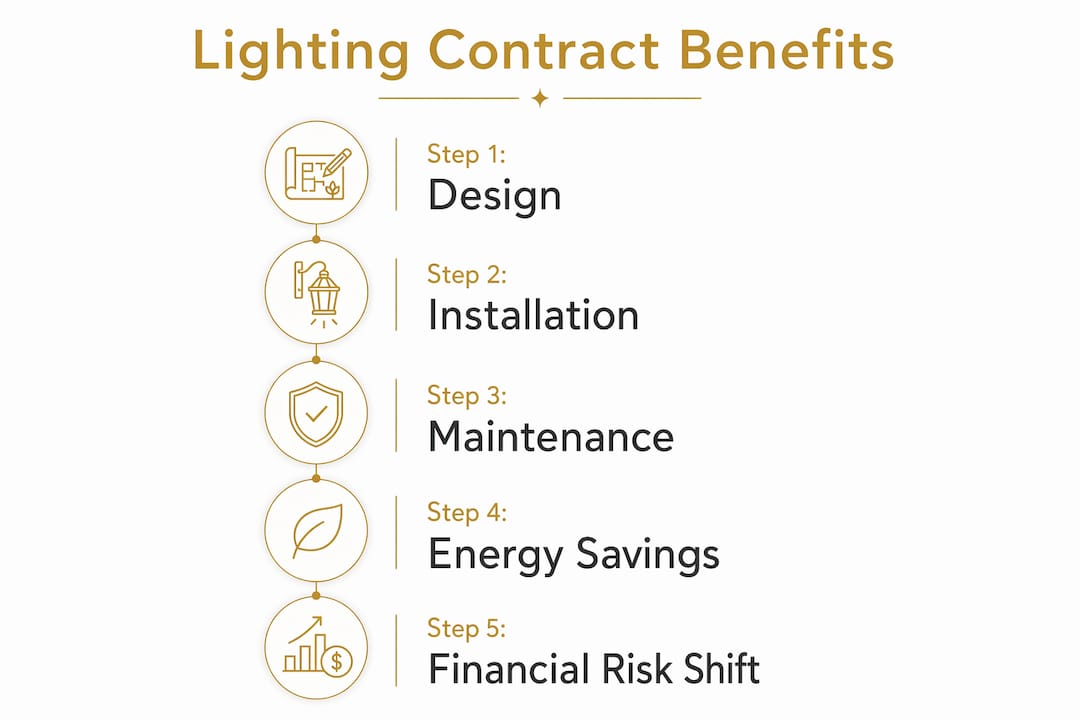
The financial logic runs deeper than cash flow. Providers are directly incentivized to install energy-efficient technology because their profit depends on keeping maintenance costs low over the contract term. That alignment of interests is one of the strongest arguments for this model. Your provider wants your system to perform well because underperformance costs them money, not you.
Property managers overseeing multiple sites find this structure particularly useful. Predictable monthly payments across a portfolio make budgeting straightforward. There are no surprise capital requests when a fixture fails or a system needs upgrading.
Three financial realities every property owner should understand before signing:
- Early termination carries penalties. Buy-out costs can be significant if you need to exit before the contract ends. Read the termination clause carefully.
- Long-term commitments require confidence in the provider. A 5-year agreement with a provider who goes out of business creates real problems. Verify financial stability before committing.
- Total cost of ownership matters more than monthly fee. A lower monthly payment over a longer term may cost more in total than a higher payment over a shorter term.
"Full-service contracts are financial tools as much as operational ones. The best agreements align provider incentives with client outcomes over the full contract term." — Signify, Light as a Service
What service levels and response times should you expect?
Service level definitions separate a good lighting service agreement from a risky one. Premium contracts specify tiered response times for different severity levels. A complete system failure at a commercial property warrants a different response than a single burned-out fixture in a residential garden.
Standard agreements typically promise next-business-day response for non-emergency repairs. Premium agreements go further. Emergency response guarantees of 2–4 hours for critical failures are common in well-structured premium contracts. That speed matters for safety-critical applications like parking structures, building perimeters, and main entry lighting.
Premium agreements also offer financial advantages on repairs outside the base scope. Discounts of 15% on out-of-scope repairs are a standard feature in higher-tier agreements. That discount adds up over a multi-year contract, especially on complex systems with many fixture types.
| Feature | Standard agreement | Premium agreement |
|---|---|---|
| Routine maintenance | Included | Included |
| Emergency response time | Next business day | 2–4 hours |
| Parts discount | Not included | Up to 15% off |
| Proactive monitoring | Not included | Included |
| Technology upgrades | Not included | Scheduled every 5 years |
Pro Tip: Request a sample service call log from your provider before signing. Real response time data from existing clients tells you far more than a contractual promise.
How does lighting design add value to full service contracts?
Design quality is what separates a full service lighting contract from a basic equipment rental. Photometric analysis uses advanced tools to calculate exactly how light will distribute across a space before a single fixture is installed. That analysis prevents over-lit and under-lit zones, reduces energy waste, and produces a result that looks intentional rather than accidental.
A lighting designer's role in principal homes extends well beyond fixture selection. Expert designers balance electric light with available daylight, which improves both energy efficiency and visual comfort. For a residential estate, that balance shapes how the property looks at dusk, at night, and during the day from inside.
High-end full service contracts also integrate lighting with building management systems and smart controls. That integration means your lighting responds to occupancy, time of day, and natural light levels automatically. For commercial properties, that responsiveness directly reduces energy costs. For residential estates, it creates a living environment that adjusts to how you use each space.
The benefits of this design depth include:
- Consistent light quality across all zones, with no harsh transitions between bright and dark areas.
- Energy reduction through daylight harvesting and occupancy-based controls.
- Architectural enhancement that highlights the features of your property rather than simply illuminating it.
- Scalability as your property evolves, because a well-documented design is easy to extend or modify.
For architectural lighting on large estates, custom photometric design is not optional. It is the foundation of every decision that follows.
Key Takeaways
A full service lighting contract is the most complete way to manage your property's lighting because it transfers technical risk to the provider, converts capital costs to predictable payments, and guarantees performance across the full contract term.
| Point | Details |
|---|---|
| Definition and structure | A LaaS agreement bundles design, installation, maintenance, and upgrades into one fixed recurring fee. |
| Contract duration | Terms typically run 2–5 years, with longer terms carrying lower monthly fees but higher exit costs. |
| Financial benefit | Converting CapEx to OpEx improves cash flow and removes large upfront spending from your budget. |
| Service level matters | Premium agreements include 2–4 hour emergency response and discounts on out-of-scope repairs. |
| Design drives value | Photometric analysis and smart controls distinguish full service contracts from basic equipment agreements. |
What I've learned after years of lighting contracts
The biggest mistake I see property managers make is treating a lighting service agreement as a commodity purchase. They compare monthly fees across providers and choose the lowest number. That approach almost always leads to regret.
The monthly fee is the least important number in the contract. What matters is the response time guarantee, the definition of what is and is not covered under maintenance, and the exit terms. I have seen agreements where "maintenance" covered only labor and the client paid full retail for every part. I have seen emergency response clauses that defined "emergency" so narrowly that a full exterior lighting failure did not qualify.
My honest advice: read the termination clause before you read the pricing. If the buy-out cost is punishing, you are locked in regardless of how the provider performs. Negotiate that clause first, then work backward to the monthly fee.
The providers worth working with welcome that conversation. They know their service is strong enough to retain clients without punitive exit terms. If a provider resists negotiating the termination clause, that tells you something important about how they expect the relationship to go.
Full service contracts are genuinely excellent tools when the terms are right. The financial logic is sound, the risk transfer is real, and the design quality available at the premium tier is far beyond what most property owners could manage independently. Get the terms right, and this model works beautifully.
— Chris
Elegant Outdoor Lights: full service lighting for distinguished properties
Elegant Outdoor Lights delivers the complete lighting service experience for residential estates and commercial properties across Los Angeles, including Bel Air, Beverly Hills, Pacific Palisades, and Malibu. Every project begins with a custom design consultation at dusk, so the final result reflects how your property actually looks after dark.
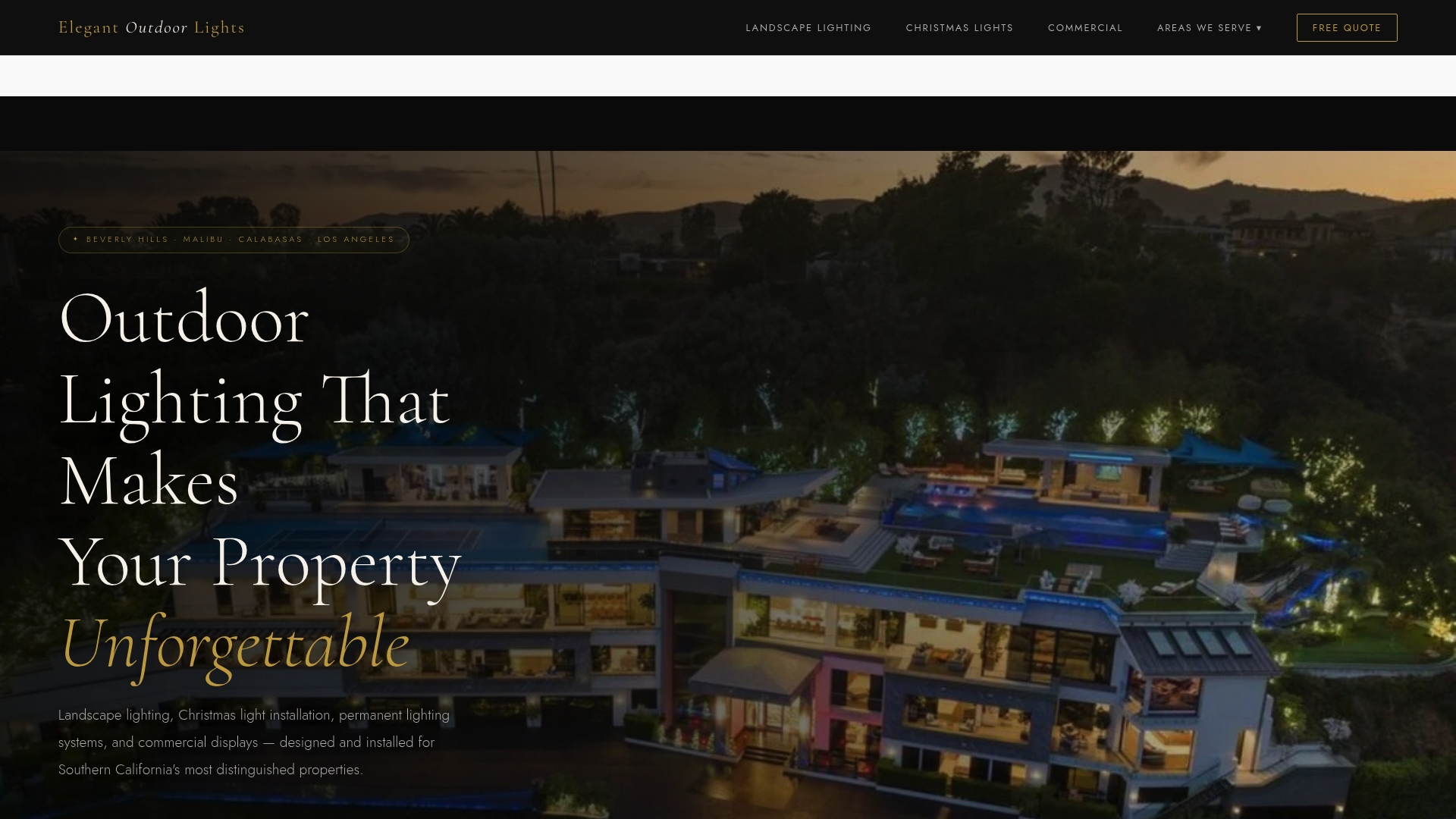
From professional holiday lighting installation to permanent landscape lighting design and commercial lighting services, Elegant Outdoor Lights handles design, installation, and ongoing care as a single-source provider. Property managers appreciate the predictable budgeting. Estate owners appreciate the result. Contact Elegant Outdoor Lights to discuss a lighting service agreement built around your property's specific needs.
FAQ
What is a full service lighting contract?
A full service lighting contract, also called Lighting as a Service, is a subscription agreement where the provider handles design, installation, maintenance, and upgrades for a fixed recurring fee. Contract terms typically run 2–5 years.
What does a lighting service agreement typically include?
Most agreements include a site survey, photometric design, turnkey installation, ongoing maintenance, parts replacement, and performance guarantees. Premium tiers add technology upgrades and priority emergency response.
How do full service lighting contracts affect my budget?
These contracts convert upfront capital costs into predictable monthly or quarterly payments, which improves cash flow and simplifies budgeting for both residential and commercial properties.
What response times should I expect for repairs?
Standard agreements promise next-business-day response for non-emergency repairs. Premium agreements guarantee emergency response within 2–4 hours for critical system failures.
Can I exit a full service lighting contract early?
Early termination is possible but typically involves buy-out costs that can be significant. Review the termination clause carefully and negotiate its terms before signing any agreement.