
TL;DR:
- Estate exterior illumination uses layered lighting to enhance safety, architecture, and security on large properties. Professionals design zoning control, choose durable fixtures, and conduct nighttime demos to create aesthetic, functional systems. Proper lighting balances darkness and brightness, increasing property value and deterring crime without sacrificing beauty.
Estate exterior illumination is defined as the intentional, layered lighting of a property's outdoor spaces to highlight architectural features, guide safe navigation, and deter unauthorized access. The industry term used by professionals is architectural landscape lighting, and understanding estate exterior illumination what means in practice separates a thoughtfully designed property from one that simply has lights installed. Professionally designed estate lighting can increase property value by up to 20% by enhancing curb appeal and drawing attention to the home's best features. That figure reflects something most homeowners underestimate: lighting is not decoration. It is a long-term investment in how your property looks, feels, and functions after dark.
The Illuminating Engineering Society (IES) sets the professional standards that guide exterior lighting design across residential and commercial properties in the United States. Those standards treat safety as the first priority, aesthetic form as the second, and mood as the third. Elegant Outdoor Lights applies this same hierarchy to every estate project it designs in Bel Air, Beverly Hills, Pacific Palisades, and Malibu.
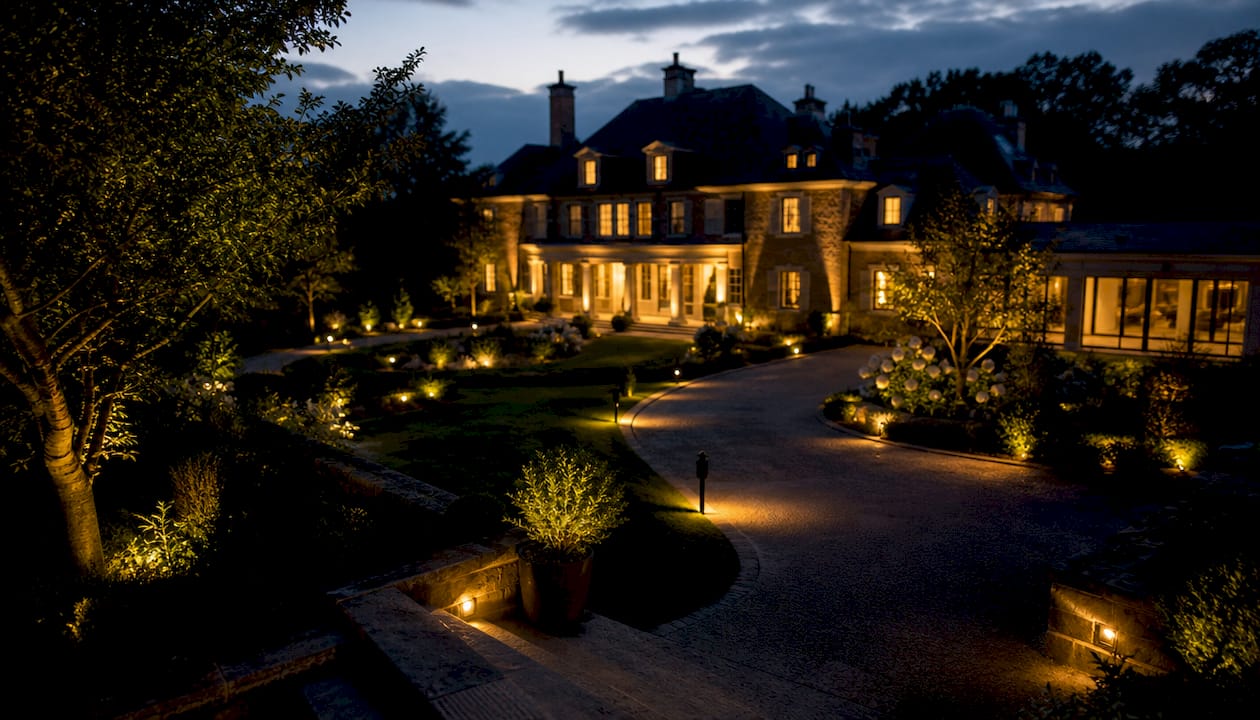
What does estate exterior illumination mean for your property?
Outdoor illumination is not just functional. At the estate level, it is an extension of the architectural design narrative, restoring visibility and character that daylight reveals but darkness erases. When the sun sets on a property with mature oak trees, a stone facade, and a motor court, the right lighting system makes those features as compelling at 10:00 PM as they are at noon.
The three core objectives of estate exterior illumination are safety, architectural expression, and atmosphere. Each one builds on the last.
Safety and navigation come first. Pathways, steps, grade changes, and entry points all create hazards in the dark. Illuminating these areas protects guests, residents, and staff from injury. Lighting pathways and entrances also signals to visitors where to walk and where not to, which matters on large estates where the grounds can be disorienting at night.
Architectural and landscape expression comes second. Light reveals texture, depth, and form in ways that a daytime observer takes for granted. A well-placed uplight on a stone column shows every shadow and grain. A downlight through a canopy of trees creates a dappled pattern on the ground that no daytime photograph can replicate.
Mood and atmosphere complete the picture. The goal is not brightness. It is the right quality of light in the right places, with deliberate darkness used as a design tool to focus attention and prevent visual clutter.
- Pathway lights should guide without blinding. Low-profile bollard fixtures or in-ground LEDs keep the light at ankle level.
- Accent lights on specimen trees or architectural details should use narrow beam angles (typically 15–36 degrees) to concentrate light precisely.
- Ambient fill light softens harsh shadows between focal points without flooding the space.
Pro Tip: Walk your property at night before any lighting design begins. Note where you feel unsafe, where the architecture disappears, and where existing light sources create glare. That walk is the most honest brief a designer can receive.
How does professional estate lighting design differ from standard outdoor lighting?
Standard outdoor lighting solves a single problem: visibility. Professional estate lighting design solves a system of problems simultaneously, and the difference in approach is significant.
-
Scale and zoning. Large estates require zoned lighting systems that control pools, gardens, facades, driveways, and perimeter areas independently. A single switch for the entire property is not a design. It is a shortcut. Zoning lets you set a welcoming scene for a dinner party, a security mode for an unoccupied property, and a low-energy overnight setting, all from one control panel.
-
Fixture quality and durability. Estate-grade fixtures use weatherproof brass, copper, or marine-grade aluminum housings built to last decades in outdoor conditions. Standard residential fixtures often use plastic or coated steel that degrades within a few years. The difference shows up in color consistency, beam stability, and maintenance costs over time.
-
Design philosophy. Professional designers approach a property the way a cinematographer approaches a film set. The question is never "how much light?" It is "what do we want the viewer to see, and from where?" Architectural lighting reveals form rather than flooding it. That distinction separates a designed estate from a well-lit parking lot.
-
Onsite nighttime demonstrations. Nighttime demo installations allow designers to test beam angles, intensity levels, and fixture placement against the actual architecture before committing to a permanent installation. No rendering or plan can replicate what the eye sees in real conditions. This step is standard practice for Elegant Outdoor Lights on every estate project.
Pro Tip: Ask any lighting designer whether they conduct a nighttime demo before finalizing the design. If the answer is no, the design is based on assumptions, not observation.
The result of professional design is a system that serves both aesthetics and function without compromise. It also ages well, because quality fixtures and thoughtful placement do not go out of style the way trendy products do.
What are the common types and techniques of estate exterior lighting?
Estate lighting draws from a defined set of techniques, each suited to specific applications. Understanding these techniques helps you evaluate a design proposal and ask the right questions.
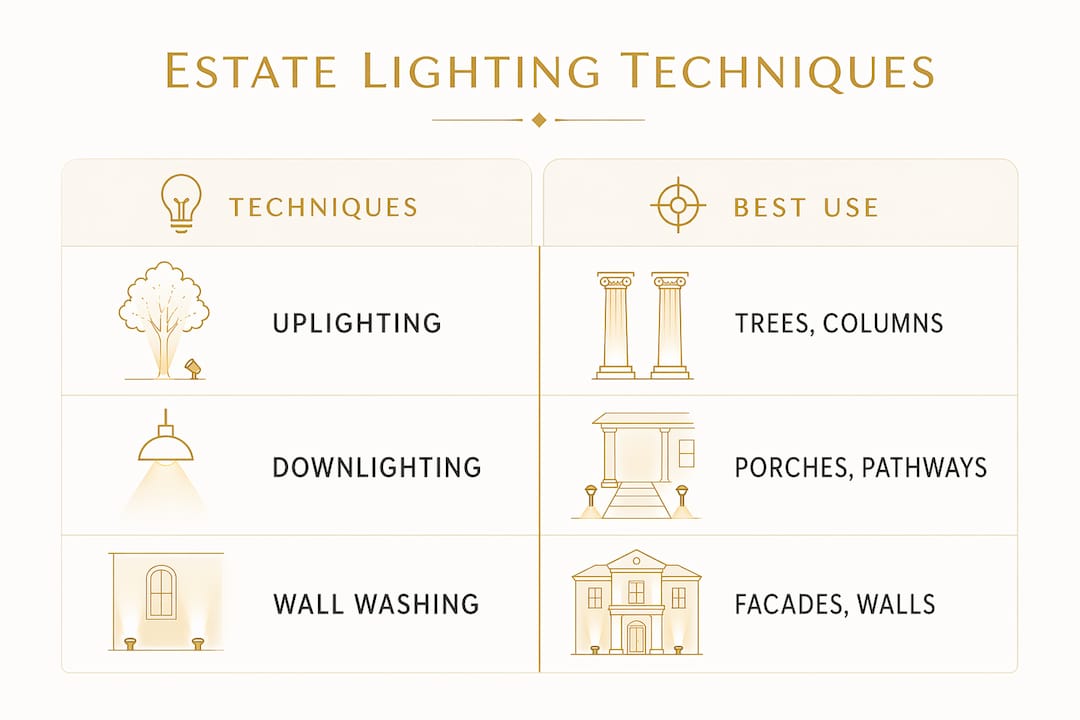
| Technique | Best use | Typical beam angle |
|---|---|---|
| Uplighting | Trees, columns, facades | 15–36 degrees |
| Downlighting | Pathways, seating areas, steps | 36–60 degrees |
| Wall washing | Textured walls, hedges, gates | 60 degrees or wider |
| Path lighting | Walkways, driveways, borders | Omnidirectional or 120 degrees |
| Accent lighting | Sculptures, water features, specimen plants | 10–15 degrees |
These fixture types and beam angles are the building blocks of every professional estate lighting plan. The skill lies in combining them.
Uplighting is the most dramatic technique. Placing a fixture at the base of a tree or column and directing light upward creates height and presence. The narrower the beam, the more focused and theatrical the effect. Wider beams soften the look and work better for large canopy trees.
Downlighting mimics natural light falling from above, which makes it the most comfortable technique for human activity areas. Fixtures mounted in trees or on structures cast soft pools of light that feel organic rather than artificial. This technique works particularly well for driveway lighting on long estate approaches.
Wall washing uses wide-beam fixtures placed close to a surface to reveal texture across a broad area. Stone walls, stucco facades, and clipped hedges all benefit from this technique. The light grazes the surface at a low angle, making every shadow and grain visible.
Layered light sources at low intensity create depth and prevent the flat, washed-out effect of floodlighting. That layering is what gives a professionally lit estate its three-dimensional quality at night. A single floodlight achieves brightness. A layered system achieves atmosphere.
- Use uplighting for vertical drama on trees and architecture.
- Use downlighting for comfort and activity in outdoor living areas.
- Use wall washing to reveal surface texture on facades and garden walls.
- Use path lighting to define circulation routes without creating glare.
- Use accent lighting sparingly on focal points like sculpture or water features.
How does estate exterior illumination improve security without sacrificing aesthetics?
Security and beauty are not competing goals in estate lighting. They are the same goal approached from two directions. Effective estate lighting deters crime by eliminating dark corners, but it does so without the harsh floodlights that make a property look like a commercial facility.
The key principle is coverage without glare. Every dark zone on a property is a potential vulnerability. A professional lighting plan maps those zones and addresses each one with a fixture type that fits the context. A dark stretch of perimeter hedge gets low-profile path lights or in-ground uplights. A shadowed entry alcove gets a recessed downlight. The result is complete coverage that reads as elegant, not defensive.
- Entrances and gates benefit from downlighting that illuminates faces and license plates clearly without creating harsh shadows.
- Driveways need consistent light levels from the street to the motor court, eliminating the dark gaps where visibility drops.
- Perimeter plantings can conceal motion-activated fixtures that activate only when needed, preserving the nighttime aesthetic while adding a deterrent layer.
- Vulnerable zones such as side yards and service entrances get low-level ambient light that removes concealment without drawing attention to those areas.
Privacy is also part of the security equation. Lighting that spills beyond the property boundary creates light pollution and draws attention to the estate from the street. A well-designed system keeps light on the property and directs it inward. Exterior lighting that eliminates dark areas deters unauthorized activity while maintaining the visual character of the estate. That balance is what distinguishes a security-conscious design from a security-obsessed one.
Key Takeaways
Estate exterior illumination is the intentional, layered use of architectural landscape lighting to enhance safety, reveal architectural form, and deter unauthorized access on large properties.
| Point | Details |
|---|---|
| Definition matters | Estate exterior illumination means strategic, layered lighting for safety, aesthetics, and security. |
| Property value impact | Professional lighting design can increase estate value by up to 20% through enhanced curb appeal. |
| Zoning is non-negotiable | Large estates require independently controlled lighting zones for gardens, facades, and perimeter areas. |
| Technique selection | Uplighting, downlighting, wall washing, and path lighting each serve distinct purposes and beam angles. |
| Security without compromise | Eliminating dark zones deters crime without harsh floodlights, preserving the estate's visual character. |
What I've learned from lighting estates after dark
The most common mistake I see on large properties is over-lighting. Homeowners assume that more light means more safety and more beauty. The opposite is true. Excessive brightness flattens a facade, washes out texture, and creates glare that makes the surrounding darkness feel more threatening, not less.
The properties that look genuinely extraordinary at night are the ones where darkness is used deliberately. Light falls on the stone column, not the wall behind it. The oak tree glows from within its canopy, but the lawn beneath stays dark. That restraint is what creates depth and drama. It is also what makes a property feel private and secure rather than exposed.
I have also learned that no design survives first contact with the actual site unchanged. Every property has surprises: a reflection off a window that creates unwanted glare, a tree that blocks a planned sightline, a grade change that shifts the angle of a fixture. Nighttime demos exist precisely because drawings cannot capture these realities. Any designer who skips that step is guessing.
The long-term value of professional estate lighting is not just aesthetic. It is financial. A property that photographs beautifully at night, that feels safe and welcoming after dark, and that has a lighting system built from quality fixtures commands a different position in the market than one that does not. That is not a subjective opinion. It is reflected in architectural lighting's effect on property value.
— Chris
Elegant Outdoor Lights: professional estate lighting for Los Angeles properties
Elegant Outdoor Lights designs and installs architectural landscape lighting for private estates across Bel Air, Beverly Hills, Pacific Palisades, and Malibu. Every project begins with an onsite consultation at dusk, where the design is shaped by the actual architecture and grounds rather than assumptions made in an office.
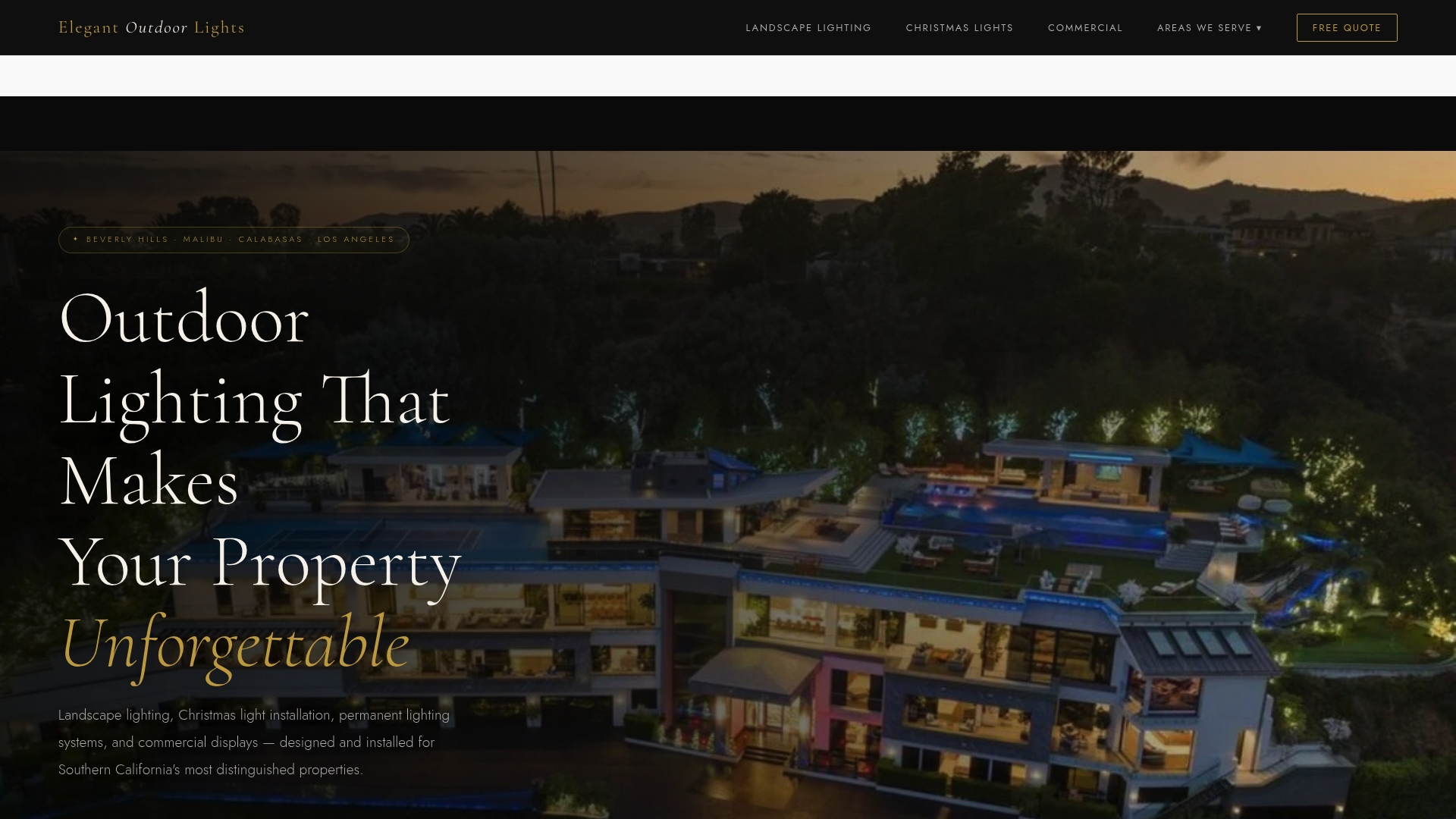
The team handles everything from initial design through installation, maintenance, and seasonal updates. For homeowners who want a property that looks as considered at 10:00 PM as it does at noon, Elegant Outdoor Lights delivers that result with fixtures built for longevity and designs built for the specific character of each estate. Reach out to schedule your consultation and see what your property looks like after dark when the lighting is done right.
FAQ
What is estate exterior illumination?
Estate exterior illumination is the professional, layered lighting of a large property's outdoor spaces to serve safety, architectural expression, and security simultaneously. It uses techniques like uplighting, downlighting, and wall washing rather than simple floodlighting.
How does estate lighting differ from standard outdoor lighting?
Estate lighting uses zoned control systems, commercial-grade weatherproof fixtures, and onsite nighttime design demos. Standard outdoor lighting typically addresses only basic visibility without considering architectural form or property-wide coverage.
What types of fixtures are used in estate exterior lighting?
The primary fixture types are uplights, downlights, wall washers, path lights, and accent lights. Each serves a specific purpose, with beam angles ranging from 10 degrees for tight accent work to 120 degrees or wider for broad path illumination.
Can exterior lighting actually improve property security?
Exterior lighting deters unauthorized access by eliminating dark zones around entrances, driveways, and perimeter plantings. The most effective security lighting achieves full coverage without harsh floodlights that compromise the property's visual character.
Does professional landscape lighting increase property value?
Professional architectural landscape lighting can increase property value by up to 20% by improving curb appeal and highlighting the architectural features that make an estate distinctive.