
TL;DR:
- Homeowners must follow code standards like GFCI protection and proper fixture placement to ensure outdoor lighting safety. Regular maintenance, correct wiring, and strategic positioning reduce hazards and enhance security. Professionals recommend deeper cable burial and beyond-minimum precautions for long-lasting, safe outdoor lighting systems.
Outdoor lighting safety for homeowners is defined as the practice of using code-compliant equipment, correct installation methods, and proper fixture placement to prevent electrical hazards, reduce accidents, and improve property security. The 2026 National Electrical Code (NEC) now requires GFCI protection on all 120V outdoor receptacles supplying luminaires, a significant update that directly affects how you wire and power exterior fixtures. Standards from the NEC and the Electrical Safety Foundation International (ESFI) set the baseline for safe outdoor lighting installation. Getting these fundamentals right protects your family, your property, and your investment in exterior lighting.
What electrical safety precautions must homeowners follow for outdoor lighting?
Electrical safety is the foundation of every safe outdoor lighting setup. The 2026 NEC Section 210.8(F) extends GFCI requirements to all 120V outdoor circuits supplying luminaires, regardless of fixture type or location. That means any outlet powering a wall sconce, floodlight, or plug-in transformer must have GFCI protection.
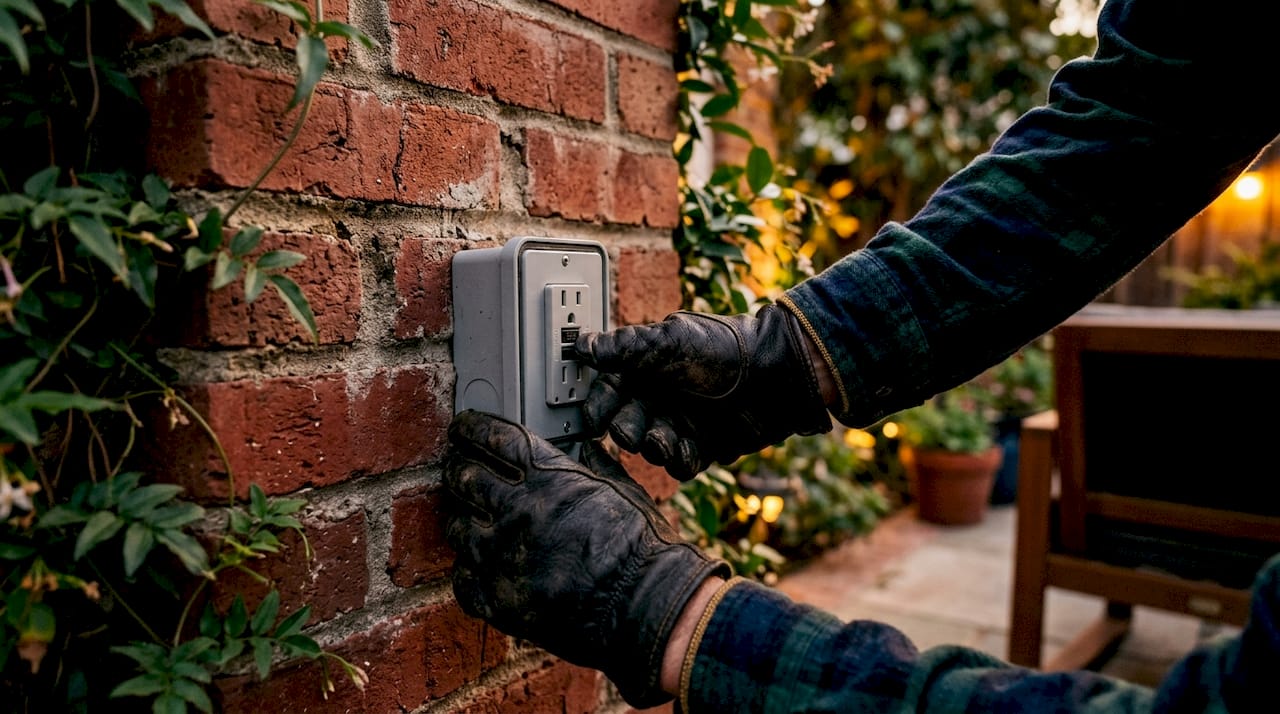
Beyond code compliance, the equipment you choose matters just as much as the wiring. Every fixture, extension cord, and outlet cover must carry an outdoor rating. Use weatherproof "in-use" covers rated as "extra-duty" to fully seal receptacles even when cords are plugged in. Standard indoor covers leave gaps that allow moisture to reach live contacts, which creates shock and fire risks.
Electrical load management is another area homeowners frequently overlook. For low-voltage landscape systems, the 80% continuous load rule applies to transformers: a 300W transformer should power no more than 240W of connected fixtures. Exceeding that threshold causes overheating, which shortens transformer life and creates a fire hazard.
Wiring burial depth is also governed by code. The minimum burial depth for low-voltage wiring is 6 inches, though professionals routinely recommend 8–12 inches in high-traffic yards. Deeper burial protects cables from shovels, aerators, and other landscape tools that can nick insulation and create dangerous faults.
Key electrical safety precautions to follow:
- Use only UL-listed, outdoor-rated fixtures and extension cords
- Install GFCI protection on every 120V outdoor circuit per NEC 2026 Section 210.8(F)
- Fit all outdoor receptacles with extra-duty weatherproof in-use covers
- Keep transformer load at or below 80% of rated wattage
- Bury low-voltage wiring at least 6 inches deep, preferably 8–12 inches
- Use connectors rated for wet or direct-burial environments to prevent corrosion
Pro Tip: Press the test button on every GFCI outlet monthly. A functioning GFCI device trips immediately when tested. If it does not trip, replace the device before using the circuit.
How should you plan and position outdoor lighting for maximum safety and security?
Placement determines whether your lighting actually prevents accidents or creates new ones. A common mistake is installing too many bright fixtures without considering where the light lands. Aiming lights downward and shielding the source reduces glare and eliminates harsh shadows that increase slip-and-fall risk near pools, steps, and uneven terrain. More light does not automatically mean safer light.
Follow this positioning sequence for a safe, well-lit property:
- Map hazard zones first. Identify steps, grade changes, pool edges, and driveway entries before placing a single fixture. These areas need consistent, glare-free illumination.
- Mount floodlights at least 9 feet above ground. At that height, floodlights achieve optimal beam spread and stay out of reach of casual vandalism.
- Space pathway lights evenly. Uneven spacing creates dark gaps between fixtures. Those gaps are where slip-and-fall accidents happen. Aim for consistent pools of light with slight overlap.
- Position motion sensors at entry points. Place motion-activated lights at garage doors, side gates, and back entrances. Sudden illumination deters opportunistic intruders more reliably than lights left on all night.
- Keep fixtures away from trees and shrubs. Foliage can trap heat around fixtures and create fire risk. Maintain at least 12 inches of clearance between any fixture and plant material.
- Avoid lighting toward the street. Fixtures aimed at the road blind drivers and pedestrians. Angle all lights inward toward your property.
Security-focused lighting works best when it combines timed ambient lighting with motion-activated accents. Timed lights signal occupancy. Motion lights signal detection. Together, they cover both deterrence and response.
For exterior wall lighting, mount fixtures at eye level on either side of entry doors rather than above them. Overhead placement creates shadows on faces, which defeats the purpose of identifying visitors.
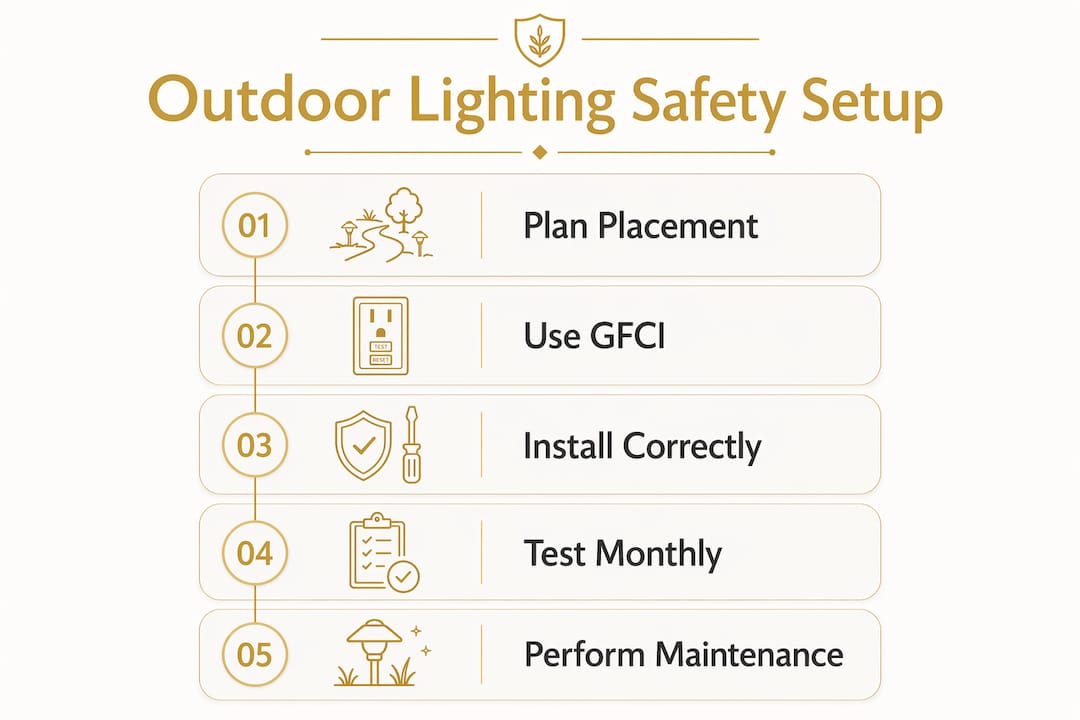
What steps should homeowners take to install and maintain outdoor lighting safely?
Safe installation starts before you touch a single wire. Gather the right tools and protective gear: insulated screwdrivers, a non-contact voltage tester, wire strippers, waterproof wire nuts or direct-burial connectors, and safety glasses. Never work on a live circuit. Turn off the breaker and confirm the circuit is dead with your voltage tester before making any connections.
Follow these installation steps for a safe, code-compliant result:
- Turn off power at the breaker and verify with a non-contact voltage tester
- Mount fixtures to rated junction boxes designed for outdoor use and the fixture's weight
- Use direct-burial connectors for all splices and connections exposed to soil or moisture
- Seal all conduit entries with weatherproof caulk to block moisture from traveling into boxes
- Bury wiring beyond the code minimum to protect against landscape maintenance damage
- Connect the transformer to a GFCI-protected outlet and test before burying any cable
Improper connectors are one of the most common causes of outdoor lighting failures. Corrosion at a bad splice increases electrical resistance, which generates heat and can cause insulation to melt. Always use connectors rated for wet or direct-burial environments, not standard indoor wire nuts.
Pro Tip: Before burying cable, run the system at full load for 30 minutes and check every connection point for warmth. A warm connector signals a poor splice that will fail under sustained load.
Ongoing maintenance is what keeps a safe system safe over time. Schedule these checks at least twice a year, ideally in spring and fall:
| Maintenance Task | Frequency | Why It Matters |
|---|---|---|
| Test all GFCI devices | Monthly | Confirms shock protection is active |
| Inspect wiring for damage | Twice yearly | Catches nicks or corrosion before faults develop |
| Clean fixture lenses | Twice yearly | Maintains light output and prevents heat buildup |
| Check transformer load | Annually | Prevents overheating from added fixtures |
| Inspect burial depth at erosion points | Annually | Ensures cables stay protected underground |
For driveway lighting installations, pay special attention to cable runs that cross vehicle paths. Even properly buried cable can shift over time due to soil movement or vehicle weight. Mark cable routes so you never accidentally cut through them during landscaping.
How to troubleshoot and avoid common outdoor lighting safety hazards?
Flickering lights, tripping breakers, and burnt smells are all warning signs that demand immediate attention. Flickering usually signals a loose connection, a failing GFCI device, or a voltage drop problem in a long cable run. Tripping breakers indicate an overloaded circuit or a ground fault. A burnt smell near a fixture or transformer means you have active heat damage and the circuit must be shut off immediately.
Voltage drop is a frequently overlooked cause of dim or uneven lighting. In long wiring runs, resistance in the cable reduces the voltage reaching distant fixtures. The fix is either a larger-gauge wire, a central hub layout that shortens individual runs, or both. Retail-grade landscape kits rarely account for this, which is why professionally designed systems use wire sizing calculations before installation begins.
Key warning signs and safe responses:
- Flickering lights: Check all connectors for corrosion and test the GFCI device. If flickering persists, measure voltage at the fixture.
- Tripping breakers: Reduce the load on the circuit or identify and isolate the ground fault before resetting.
- Burnt smell: Shut off the circuit immediately and do not restore power until a licensed electrician inspects the system.
- Water-damaged fixtures: Replace rather than dry and reuse. Water intrusion compromises insulation permanently.
- Dim lights at the end of a run: Increase wire gauge or shorten the run with a hub layout to correct voltage drop.
"Outdoor lighting that looks beautiful but has compromised wiring is a liability, not an asset. The infrastructure behind the fixture is what determines whether a system is safe or dangerous." — Electrical safety principle cited by licensed contractors
Line-voltage repairs (120V and above) require a licensed electrician. Low-voltage troubleshooting is more forgiving, but any repair involving the main panel, outdoor subpanel, or GFCI circuit wiring should go to a professional. Seasonal adjustments also matter: inspect all fixtures and connections after heavy rain, wind events, or freeze-thaw cycles, since these conditions accelerate corrosion and cable movement.
Key Takeaways
Safe outdoor lighting requires code-compliant electrical infrastructure, correct fixture placement, and regular maintenance to prevent hazards and protect your property.
| Point | Details |
|---|---|
| GFCI protection is mandatory | NEC 2026 Section 210.8(F) requires GFCI on all 120V outdoor circuits supplying luminaires. |
| Load limits prevent overheating | Keep transformer load at or below 80% of rated wattage to avoid fire risk. |
| Placement determines true safety | Aim lights downward and shield sources to eliminate glare and reduce accident risk. |
| Burial depth protects wiring | Bury low-voltage cable at 8–12 inches in active yards, not just the 6-inch code minimum. |
| Maintenance catches failures early | Test GFCI devices monthly and inspect all wiring and connectors twice a year. |
What I've learned from years of watching homeowners get lighting wrong
Most homeowners spend 90% of their budget on fixtures and 10% on infrastructure. That ratio should be closer to 50/50. A beautiful copper path light connected with a corroded indoor wire nut buried 3 inches deep is not a safe system. It is a slow-motion failure waiting to happen.
The 2026 NEC updates are genuinely good news for homeowners. GFCI protection on outdoor luminaire circuits closes a real gap that caused preventable shocks and fires. But code compliance is a floor, not a ceiling. The homeowners I see with the most reliable systems go beyond minimums: they use larger-gauge wire than required, bury cable deeper than code demands, and schedule professional inspections every two years.
The other thing I see consistently is glare being mistaken for safety. Bright is not the same as safe. A 1,500-lumen floodlight aimed at eye level near a pool deck creates more accident risk than a 400-lumen fixture aimed at the ground. The U.S. Department of Energy's lighting design guidance makes this point clearly, and it is one of the most underappreciated principles in residential lighting.
My honest advice: if your system is more than five years old, has never been professionally inspected, or was installed with retail-grade connectors, schedule a review before adding more fixtures. Adding load to a compromised system accelerates every existing problem. Get the foundation right first, then focus on aesthetics.
— Chris
Professional outdoor lighting that puts safety first
Elegant Outdoor Lights designs and installs code-compliant outdoor lighting systems for estates across Los Angeles, including Bel Air, Beverly Hills, Pacific Palisades, and Malibu. Every system is engineered with proper load calculations, commercial-grade connectors, and GFCI-protected circuits from the start.

Whether you need a complete landscape lighting design built to 2026 NEC standards or a professionally installed holiday lighting system that looks stunning and operates safely, Elegant Outdoor Lights handles every detail. From the initial design consultation to installation, maintenance, and seasonal removal, the process is managed entirely by our team. Contact Elegant Outdoor Lights to schedule your custom design consultation and get a system that is as safe as it is beautiful.
FAQ
What does NEC 2026 require for outdoor lighting circuits?
NEC 2026 Section 210.8(F) requires GFCI protection on all 120V outdoor receptacles and circuits that supply luminaires. This applies regardless of fixture type or mounting location.
How deep should I bury outdoor lighting cable?
The code minimum for low-voltage wiring is 6 inches, but professionals recommend 8–12 inches in yards with regular maintenance activity. Deeper burial protects cable from shovels, aerators, and soil disturbance.
What causes outdoor lights to flicker or dim?
Flickering usually signals a loose or corroded connection, while dimming at the end of a run indicates voltage drop from undersized wire or runs that are too long. Both issues require inspection and correction before they cause further damage.
How often should I test outdoor GFCI outlets?
Test every GFCI outlet monthly by pressing the test button. If the outlet does not trip immediately, replace it. GFCI devices degrade over time and can fail to protect against shock even when they appear functional.
When should I hire a professional for outdoor lighting work?
Hire a licensed electrician for any work involving 120V circuits, the main panel, or outdoor subpanels. Low-voltage troubleshooting is more accessible for homeowners, but a professional lighting designer adds value for complex layouts, load calculations, and code compliance reviews.